Herbal liquids: the quiet growth story in the botanical category
Walk the supplement aisles of a large United States grocery chain and the botanical section is mostly capsules. Walk a Caribbean, West African or Middle Eastern grocery, or scroll the bestseller lists of herbal brands online, and the story flips: dark bottles of bitters, syrups and tonics, dosed by the tablespoon, sold on taste memory and traditional use. In a public marketplace snapshot of the top one hundred United States supplement listings, the weight-management and gut-health group, where most bitters are positioned, is the largest functional cluster by unit share; treat that as a directional signal from one marketplace, not a category forecast. For a brand owner, the gap between those two shelves is the opportunity: private label herbal supplements in liquid form are under-served by factories that mostly quote capsules and gummies, and the buyers who ask for them usually know exactly what they want.
We manufacture liquid botanicals across two formats today: the ready-to-drink liquids line, which covers bitters-style bottles, syrups and 50 milliliter ampoules, and the concentrated drops line, which puts single botanicals and small blends under a dropper cap. The manufacturing logic differs more between those two than between a capsule and a tablet, and this guide walks through why.
What your customer means when they say bitters
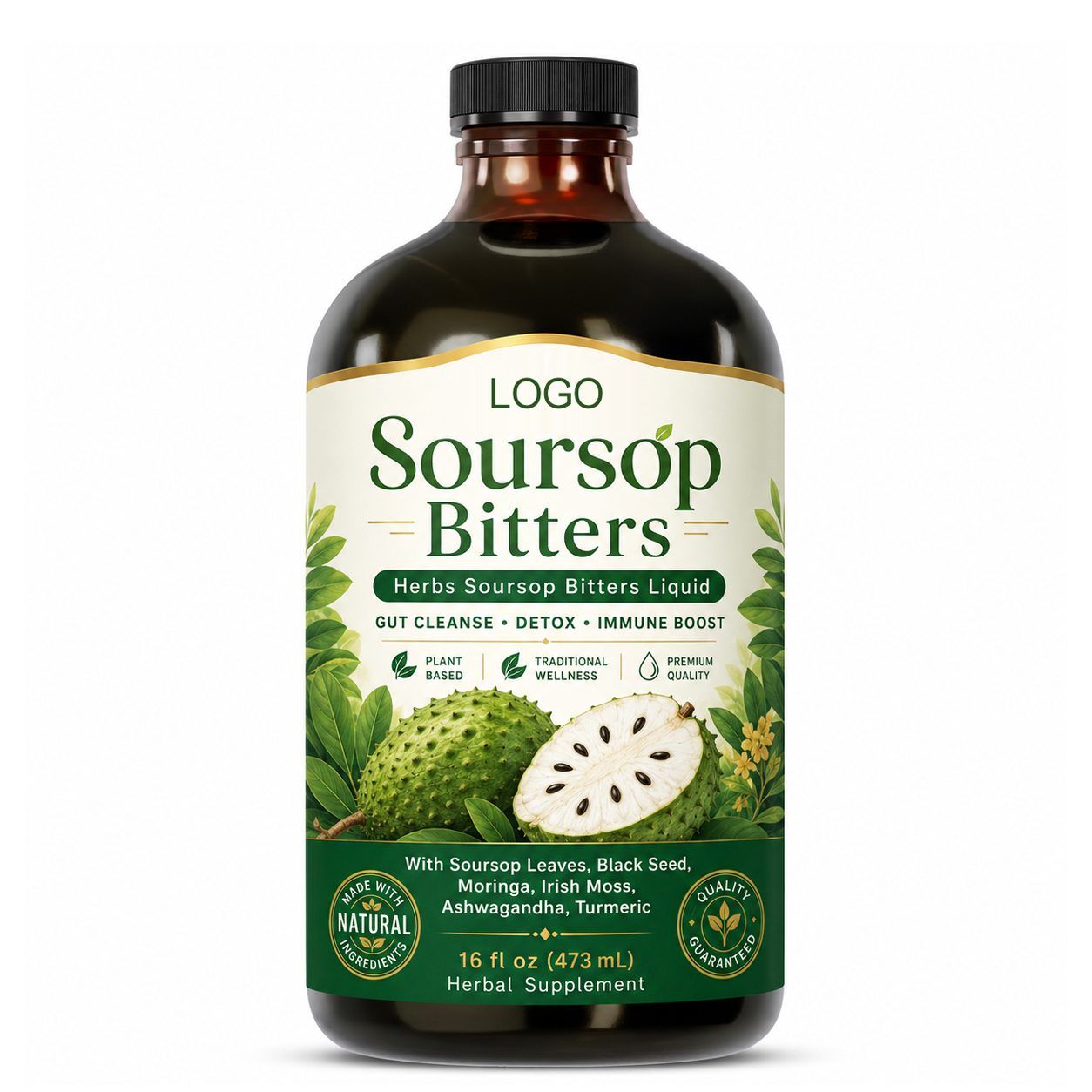
'Bitters' is a positioning word more than a technical one. On the label it usually means a multi-botanical liquid, ten to sixty plant inputs in one bottle, a dark amber container, a serving measured in tablespoons rather than drops, and a flavour that leans into bitterness instead of hiding it. A real example from our line: a 473 milliliter water-based bitters with a sixteen-item proprietary blend, soursop leaf, black seed, moringa, neem, tamarind, turmeric, ashwagandha, sea moss and ginger among them, packed in purified water with citric acid and potassium sorbate, sixteen 30 milliliter servings per bottle.
Technically that SKU is an aqueous multi-plant infusion with a preservative system, and everything that matters in production follows from those three facts. The plants are many, so identity and supply are the risk. The base is water, so preservation and water activity are the risk. The serving is large, so the per-bottle economics are unforgiving. Get those three right and the format is one of the stickiest in the industry: a customer finishes a bottle in two weeks and reorders monthly. That repurchase rhythm is why private label herbal supplements in the bitters style reward factories that keep the boring details boring.
Five ways to put a botanical in a bottle
The first technical decision in any liquid botanical project is the menstruum, the liquid system that carries the plant material. It decides extraction yield, taste, preservation, freight class and half of the claims you can legally print. Most herbal liquids fall into five process families.
| Process family | Liquid base | Typical label strength | Best suited for | Watch out for |
|---|---|---|---|---|
| Hydroethanolic tincture | Water and ethanol, often 25-60% alcohol | Marker in milligrams, or a ratio such as 1:4 | Resinous and alkaloid-bearing botanicals, single-active drops | Alcohol declaration, flammable-goods freight above about 24% ABV, sharp taste |
| Glycerite | Vegetable glycerin and water | Marker or ratio, rarely standardised | Alcohol-free claims, kids and pet lines | Glycerin extracts some markers 20-30% weaker, so extract loading and cost rise |
| Syrup | Water, sugar or honey, thickener | Extract amount per serving | Taste-first ranges, children's formats, honey sticks | Water activity and preservative math; viscosity affects fill accuracy |
| Water infusion or decoction | Purified water only | Blend total per serving | Traditional-style botanical bitters and tonics | Highest microbial and pH risk of the five; the preservative system is not optional |
| Reconstituted dry extract | Water plus a standardized powder extract | Exact marker milligrams | Vegan, sugar-free and precise-dose claims | Dispersion and sediment; usually needs a suspension aid |
Where the money actually goes in a liquid botanical SKU
Buyers new to liquids expect the plant material to dominate the quote. At retail bitters price points it usually does not. Botanical raw material for a commodity blend might land between four and twelve dollars per kilogram of extract-equivalent, and a 30 milliliter serving carries a few hundred milligrams to a few grams of botanical extract. The container, the closure, the label and the freight cube quietly take over. The split below is illustrative for a 473 milliliter water-based bitters at a pilot volume of a few thousand units, and the lesson it carries holds across most of the category.
The inversion buyers miss is the packaging line. On a 30 milliliter dropper bottle, the glass and the pipette closure can cost more than the botanical extract inside, which is why single-botanical drops carry 40 to 60 percent packaging share instead of the 15 to 25 percent typical of a capsule bottle. On the 473 milliliter bitters bottle the packaging share falls, but the freight share rises, because liquid is the heaviest format per serving on the pallet. Neither is a problem; both are arithmetic that belongs in the brief before the first quote, not after it.
Divide the bottle by the serving before you fall in love with a price. A 473 milliliter botanical bitters at one 30 milliliter tablespoon per day is sixteen servings; a 60 milliliter dropper at 0.5 milliliters is one hundred and twenty. The dropper SKU looks expensive per unit and is cheap per day; the bitters bottle looks cheap per unit and earns its margin on a two-week repurchase cycle. Compare both on a per-serving basis or the comparison is meaningless.
Standardised extract or full-spectrum: pick one and print it
The second decision is how strength appears on the label, and this is where liquid botanical projects stall most often. There are three honest positions and one dishonest one. The honest positions are a standardised extract with a named marker, a full-spectrum botanical material declared as an extraction ratio, and a proprietary blend declared as a total. The dishonest one is a blend that implies per-herb doses it does not actually carry. Pick the first position your budget and your supply chain can hold, and print it plainly.
| Approach | What the label shows | Cost behaviour | Main risk | Suits |
|---|---|---|---|---|
| Standardised extract | Turmeric root extract, 95% curcuminoids | Highest raw material cost, most stable between batches | Paying for the marker, not the plant | Functional claims, premium positioning |
| Ratio extract | 4:1 soursop leaf extract | Mid cost; drifts with the crop year | Batch-to-batch marker variance | Traditional blends with a quality story |
| Proprietary blend | 2,000 mg sixteen-plant blend | Lowest cost per label inch | No per-herb botanical dose transparency | Diaspora-style botanical bitters |
| Whole herb suspension | 1,000 mg whole leaf per serving | Cheapest raw material | Heavy sediment; the dose is not concentrated | Value lines |
Be honest with yourself about what standardisation buys. A marker percentage proves the extract is consistent and testable; it does not prove the product works, and no amount of marker content turns a traditional botanical blend into a clinically dosed one. On the other side, a sixteen-item proprietary blend is not a quality failure, it is a different contract with the customer: total content and plant identity are the promises, per-herb dosing is not. For private label herbal supplements, a manufacturer worth working with will build either version and tell you which one your budget actually supports.
Water, alcohol or glycerin: the menstruum decision
Water is the cheapest menstruum and the hardest to preserve. The bitters SKU described above runs on purified water acidified with citric acid and held with potassium sorbate, and that system only works inside a narrow chemistry window: sorbate is effective roughly between pH 4.0 and 5.5, with its pKa near 4.76, and botanical material buffers the pH upward over time. Every water-based herbal liquid on our line gets a pH target written into the specification and a twenty-eight-day preservative challenge test against USP 51 organisms before release; the acid blend is adjusted per batch, not per season. Alcohol-based tinctures preserve themselves, which is their quiet advantage, but above roughly twenty-four percent alcohol by volume an ethanol-water blend is classified as a flammable liquid for sea freight, and the freight quote changes accordingly.
- Match the menstruum to the actives: resins, alkaloids and fat-soluble botanical markers extract poorly in water alone, which is why classic bitters recipes lean on alcohol or long decoctions.
- If the claim is alcohol-free, budget for more extract: glycerin pulls some botanical markers twenty to thirty percent weaker than ethanol at equal strength, so the formula carries a higher loading to hit the same label.
- Write the pH target into the specification, not the flavour brief; a tenth of a pH unit decides whether the sorbate works.
- Treat honey-based formats like syrups: the sugar is part of the preservation, the water activity is the specification, and the microbiology panel is non-negotiable.
- Declare any added alcohol in the ingredient list and keep the finished alcohol content on the spec sheet; several destination markets also cap or separately declare it.
- Lock the water specification with a defined conductivity, because seasonal variation in process water shows up in the finished product's pH and clarity.
Bitterness is a formulation problem, not a flavour problem
In most categories bitterness is a defect; in this one it is the product. A bitters brand that ships a pleasant, fully masked liquid has usually shipped a weaker formula, because the bitter botanical compounds and the bitter taste often come from the same molecules. The practical question is not how to eliminate bitterness but how much of it the positioning can carry, and that answer differs by market: the diaspora bitters customer expects a slap, the European pharmacy customer expects discipline, and the United States e-commerce customer expects a compromise.
| Tactic | Works best with | Cost impact | Watch out for |
|---|---|---|---|
| Sweetener system: stevia, sucralose or allulose | Glycerites and botanical drops | Low | Aftertaste and clean-label objections |
| Syrup or honey base | Bitters and children's formats | Medium | Added-sugar declaration and water activity |
| Strong top notes: citrus, mint, cinnamon | Alcoholic botanical tinctures and tonics | Low to medium | Clashes with delicate botanical profiles |
| Chill-and-shoot serving ritual | Full-strength bitters | None | Positioning only; the chemistry is unchanged |
| Microencapsulated extracts | Premium drops | High | Loading limits and suspension stability |
Sediment, haze and the clarity your customer will judge
A liquid with botanical material in it wants to settle; physics does not take feedback. What separates a professional herbal liquid from an amateur one is whether the settling was designed. Every multi-botanical blend is qualified on three axes: how finely the finished liquid is filtered, from a rough five to ten micron polish that keeps texture down to a one micron polish that trades body for clarity; whether a suspension aid such as gum acacia or xanthan at 0.05 to 0.3 percent is needed to hold fine particles; and what the label honestly says about natural settling. A shake-well instruction and a stability panel at zero, one, three and six months close the loop.
- Decide the clarity story before the formula is locked: a natural, unfiltered position saves filtration cost and buys a sediment expectation you must manage.
- Suspension aids work in small doses; past about 0.3 percent xanthan the pour turns stringy and perceived quality drops.
- Dense botanical materials such as sea moss and mineral-rich powders settle fastest; grind size and pre-hydration matter more than the thickener.
- Pull stability samples on real packaging, not glass jars; the closure decides the evaporation line.
- Design the preservative system for the worst realistic consumer, because refrigeration after opening is a claim some retailers ignore.
Identity testing: what this plant means on a COA
Botanical identity is the oldest quality problem in the industry and the reason a certificate of analysis deserves line-by-line reading. The question is never just whether the bottle contains a plant, but whether it contains the right species, the right part, and the process the label claims. History supplies the stakes: aristolochic acid nephropathy happened because one look-alike herb substituted for another in weight-loss formulas, and black cohosh has been repeatedly adulterated with cheaper related species. Identity testing is how a brand stays out of those stories.
| Test | The question it answers | Where it belongs |
|---|---|---|
| Macroscopic and organoleptic review | Is this the right plant part and condition? | Every incoming lot |
| Microscopy | Do the cell structures match the species? | Every incoming lot |
| HPTLC fingerprint | Does the chemical profile match an authenticated reference? | Every lot for identity-critical herbs |
| HPLC marker assay | Is the strength claim real? | Every batch against the release specification |
| Heavy metals: lead, arsenic, cadmium, mercury | Are contaminants within limits? | Every batch |
| Pesticide residues | Does the lot meet destination-market limits? | Every lot; risk-based frequency on mature supply |
| Microbial panel and aflatoxins | Is it safe as a water-containing product? | Every batch |
| Residual solvents and ethanol content | Was the process controlled and is the label honest? | Extracted materials and alcohol-containing formulas |
A factory that cannot produce this panel per lot is not a botanical manufacturer, whatever the website says. On our line the identity panel travels with the raw material lot, the release panel travels with the finished batch, and both are attached to the batch documentation the brand receives. For a sixteen-plant blend that is a thick folder, and it is exactly the folder that survives a customs inspection or a retailer's vendor audit. For private label herbal supplements, that folder is the product's real packaging.
Bottle, dropper or stick: format and fill
Within liquid botanicals the format choice is really a dose-delivery choice, and the packaging follows from it. The five formats below cover most briefs we receive.
| Format | Typical fill | Dose delivery | Economics note | Suits |
|---|---|---|---|---|
| Amber glass dropper bottle | 30, 60 or 100 mL | 0.5 to 2 mL under a pipette | Highest packaging share; premium per-unit price | Single botanical extracts, concentrated drops |
| PET or amber bitters bottle | 473 mL (16 fl oz) | 30 mL tablespoon | Low packaging unit cost, high freight cube | Multi-botanical blends, family size |
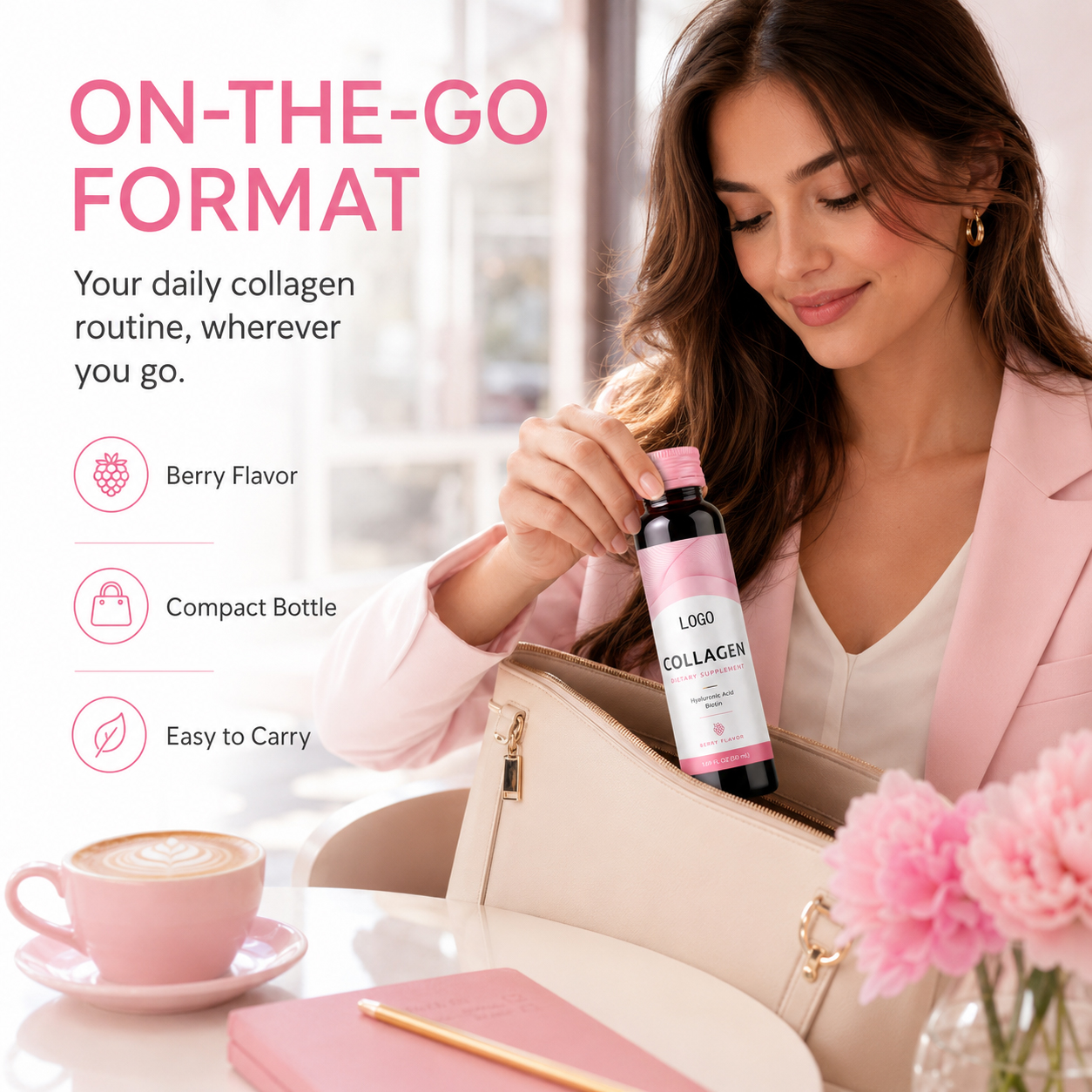
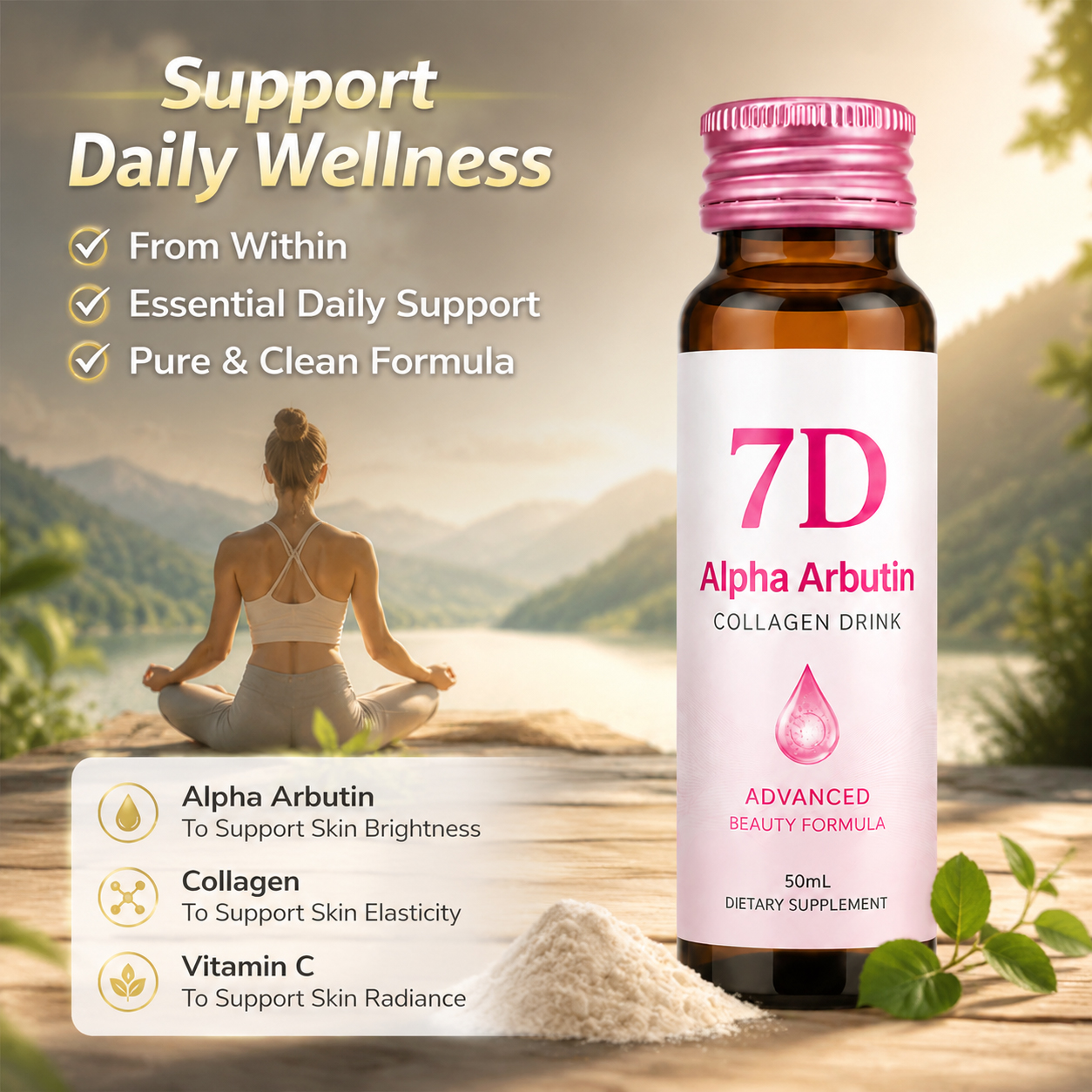
| RTD ampoule or mini bottle | 50 mL | One bottle, one serving | Most expensive packaging per serving | Beauty drinks, program-style SKUs |
| Syrup bottle with dosing cup | 150 to 250 mL | 10 to 15 mL | Mid cost; viscosity complicates filling | Children's and taste-first ranges |
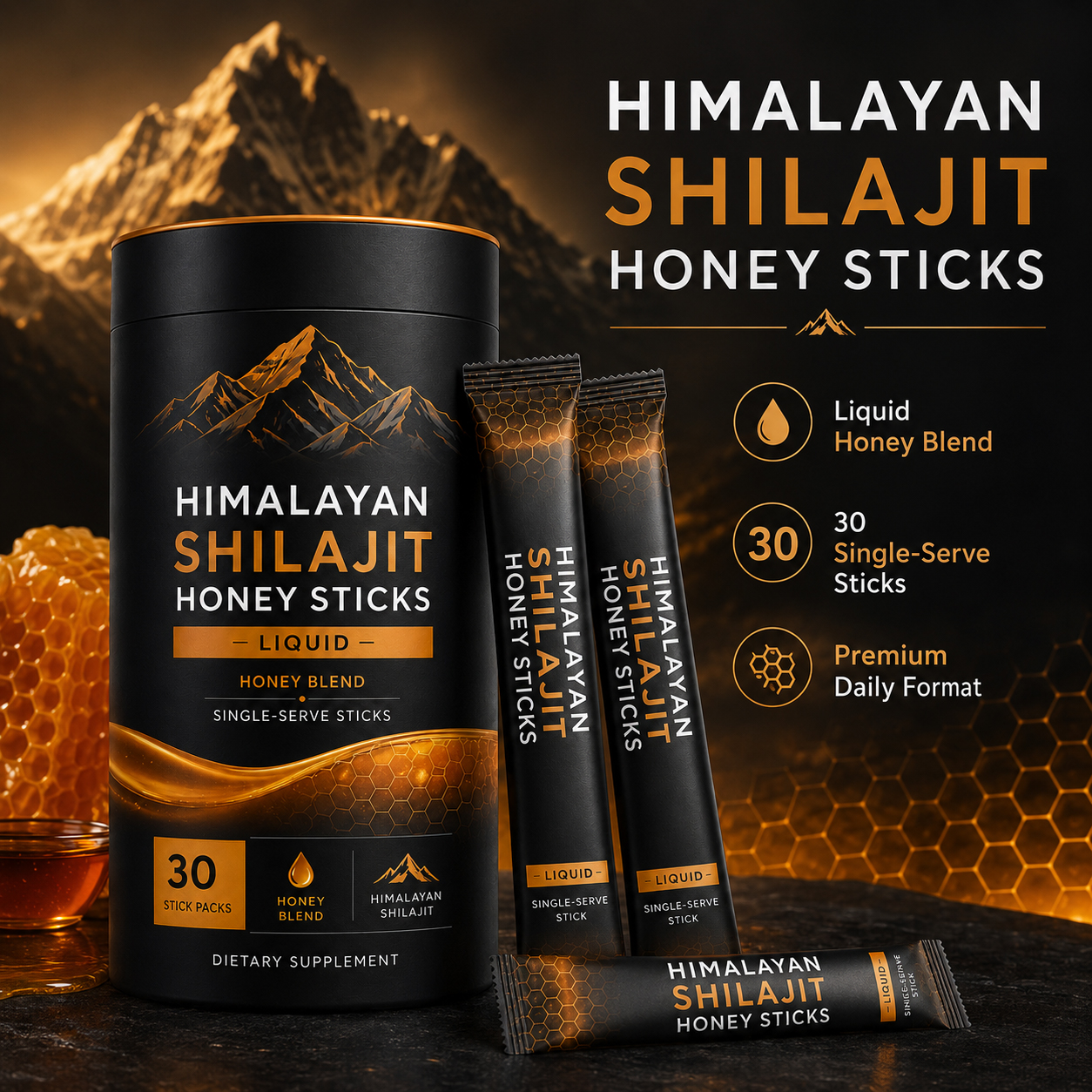
| Honey stick | 8 g single serve | One stick, one serving | Portion control at a premium; low spill risk | Shilajit and honey-based botanicals |
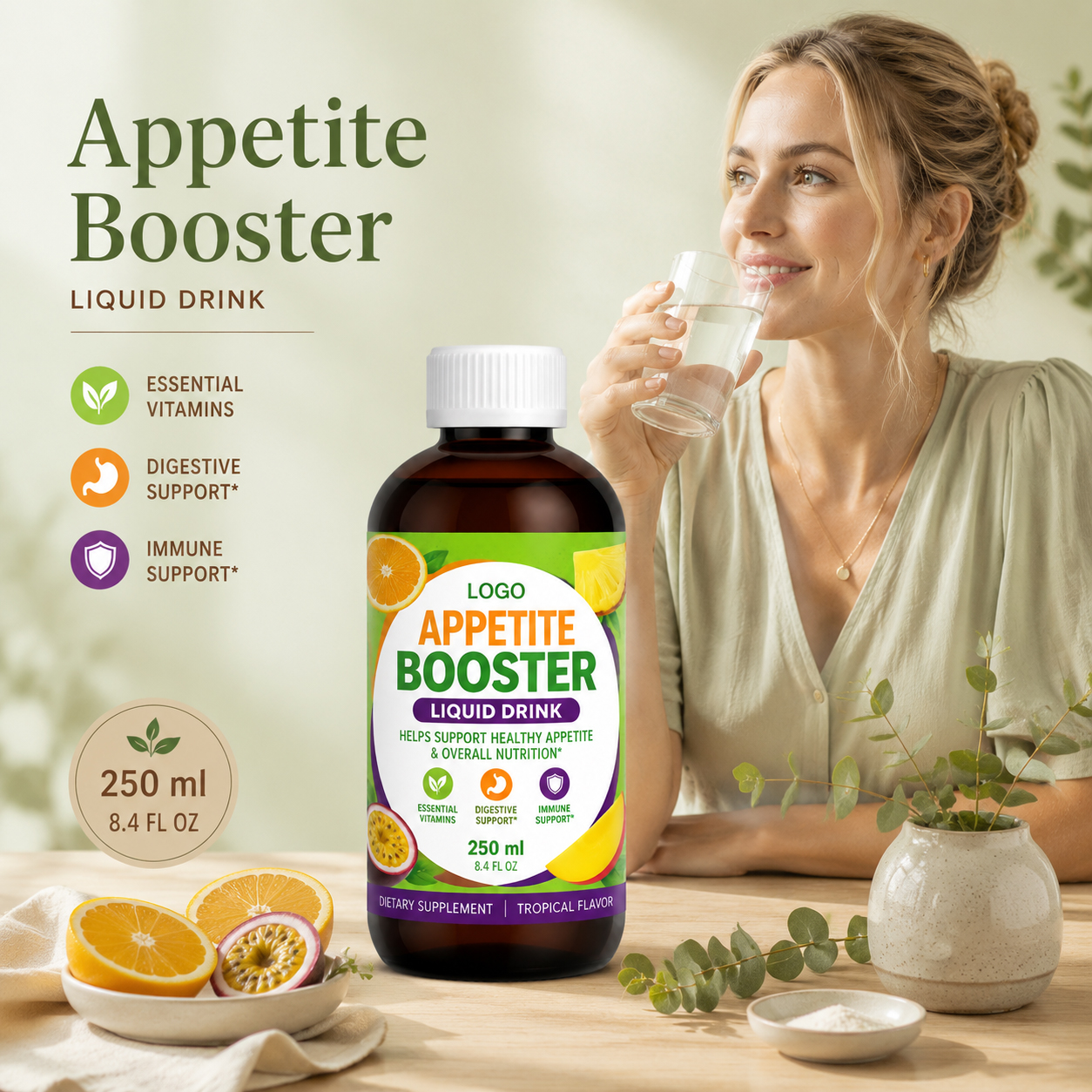
Working examples of both ends of that table are on the site: the botanical complex drops deliver a four-plant formula, garcinia, green tea, apple cider vinegar and B12, in 0.5 milliliter servings that give a 60 milliliter bottle one hundred and twenty doses, while the appetite support liquid pairs ginger, fennel and gentian with vitamins and zinc at 15 milliliter servings in a 250 milliliter bottle. For the honey end of the range, see the shilajit honey sticks and the single-ingredient black seed oil drops.
MOQ, sampling and lead time for a liquid botanical launch
The published baselines for private label herbal supplements on our liquid lines are consistent across the category: stock formulas start at 1,000 units, custom formulas carry the same floor but add development time, pre-production samples take seven to ten days, bulk production runs about fifteen working days after material release, and finished shelf life is twenty-four months with stability support. What those numbers hide is the botanical calendar. An identity-approved lot of a specific botanical extract can take two to four weeks to source and verify, longer for a standardised marker or a certified-organic grade, and a new water-based preservative system adds the challenge-test window. A realistic first order plans eight to ten weeks from formula lock to shipment, and brands that try to compress it usually compress the testing instead, which is the wrong trade.
How those numbers move with volume, packaging and incoterm is covered in the MOQ and lead times guide, and the dosage form selection guide places liquids against capsules, gummies and powders on cost, dose capacity and shipping weight.
Compliance: claims and declarations that differ by market
Private label herbal supplements sit under the same dietary supplement rules as every other format, with three additional edges. First, claims: in the United States, structure and function language with the DSHEA disclaimer is the ceiling, and a botanical that sits on an OTC drug monograph, senna being the live example inside many bitters blends, narrows what the label may say without becoming a drug. Second, the European Union: health claims run through the official claims register, and several concentrated botanical extracts raise novel food questions that must be answered before the product ships. Third, alcohol: any added ethanol is declared in the ingredient list, and transport rules apply well before labeling rules do. None of this is exotic; all of it is checkable before artwork is printed, and the factories that check it are cheaper than the recalls that do not.
The market-by-market detail is in our global regulations guide, and for the technical base of the format itself, the liquid supplements and drops guide covers pH, preservatives and dropper calibration in depth.
A ten-point brief for your first herbal liquid
- Define the serving first: tablespoon, teaspoon, dropper or stick, because it sets the bottle, the preservative load and the per-serving economics.
- Choose the menstruum honestly: water with a preservative system, a hydroethanolic tincture, or a glycerite, and accept the freight and taste consequences.
- Pick one label strength position, standardised, ratio or blend, and write the exact wording before the quote.
- List the botanical inputs with species and part, not just common names; soursop leaf and soursop fruit are different inputs with different supply.
- Flag any monograph or restricted botanical, senna, yohimbe, kava, for a destination-market check before formulation, not after.
- Set the pH and preservative specification together and order the USP 51 challenge test on the actual formula.
- Decide the clarity story, filtered and bright or natural with sediment, and put the shake-well instruction in the artwork.
- Choose the closure for the dose: pipette, dosing cup or screw cap; it is the biggest packaging cost line and the most returned component.
- Ask for the identity panel per lot and the release panel per batch in the batch documentation.
- Plan eight to ten weeks from formula lock to shipment, and sample the flavour on a real production fill, not a lab beaker.
Ready to brief your private label herbal supplements project?
Send the botanical list, the target market, the serving format and your launch volume. We will return a quote with the menstruum options, the preservative plan, the MOQ and the testing panel spelled out, usually within 24 hours.
What to hold onto from this guide
- Liquid botanicals are won on process, not ingredients: menstruum, preservation and filtration decide the product the customer actually tastes.
- Water-based bitters live or die by the preservative window: pH 4.0 to 5.5 with sorbate, proven by a 28-day challenge test.
- The serving size writes the economics: sixteen servings per 473 mL bottle versus one hundred and twenty per 60 mL dropper changes every comparison.
- Packaging, not plants, is often the largest cost line in a liquid botanical SKU at retail doses.
- Identity testing per lot is non-negotiable: HPTLC plus microscopy on incoming botanicals, HPLC on the finished batch.
- Plan eight to ten weeks from formula lock to first shipment and spend the time on testing, not on compressing it.
References
Key takeaways
- Liquid botanicals are won on process, not ingredients: menstruum, preservation and filtration decide the product the customer actually tastes.
- Water-based bitters live or die by the preservative window: pH 4.0 to 5.5 with sorbate, proven by a 28-day challenge test.
- The serving size writes the economics: sixteen servings per 473 mL bottle versus one hundred and twenty per 60 mL dropper changes every comparison.
- Packaging, not plants, is often the largest cost line in a liquid botanical SKU at retail doses.
- Identity testing per lot is non-negotiable: HPTLC plus microscopy on incoming botanicals, HPLC on the finished batch.
- Plan eight to ten weeks from formula lock to first shipment and spend the time on testing, not on compressing it.
Frequently asked questions
Can you manufacture alcohol-free herbal bitters?
Yes. Most of the bitters we build are water-based, preserved with citric acid and potassium sorbate inside the pH 4.0 to 5.5 window, or glycerin-based where an alcohol-free and sugar-free claim is needed. The trade-off is extraction efficiency: glycerin pulls some markers twenty to thirty percent weaker than ethanol, so the formula carries a higher extract load. Both routes are proven by a twenty-eight-day preservative challenge test before release.
What is the MOQ for private label herbal supplements in liquid format?
For stock formulas, 1,000 units across the liquid and drops lines. Custom formulas carry the same floor plus development time for extraction, flavour matching and preservation. Pre-production samples take seven to ten days, bulk production about fifteen working days after material release, and shelf life is twenty-four months with stability support. A realistic first order plans eight to ten weeks from formula lock to shipment.
Can you match an existing bitters flavour?
Yes, send a reference sample. We match bitterness intensity, sweetness, acidity and aroma top notes, then confirm on a production-scale fill rather than a lab beaker, because viscosity and flavour release change on the fill line. For a sixteen-plant blend, expect two to three sample rounds: the first nails the profile, the second confirms it at volume.
How do you keep a multi-botanical blend from separating over shelf life?
By designing the settling instead of hoping against it: filtration fineness chosen for the clarity position, a suspension aid such as gum acacia or xanthan at 0.05 to 0.3 percent where needed, pre-hydration of dense materials like sea moss, and honest label language with a shake-well instruction. Stability pulls at zero, one, three and six months on real packaging verify the system.
Do you provide identity testing documentation for botanical raw materials?
Every lot arrives with macroscopic review, microscopy and an HPTLC fingerprint against an authenticated reference, plus HPLC marker assay, heavy metals, pesticide residues and a microbial panel. Extracted materials add residual solvent data, and alcohol-containing formulas declare ethanol content. The full panel is attached to the batch documentation the brand receives, which is what retailers and customs officers ask for.
Which markets can you ship finished herbal liquids to?
We ship worldwide with region-appropriate labels: United States Supplement Facts panels, European Union formats, and HALAL-certified production where the destination requires it. Alcohol-containing tinctures above roughly twenty-four percent ABV move as flammable liquids by sea, which changes freight cost and paperwork, so many export brands choose water-based or low-alcohol systems. Destination-market claim checks happen before artwork is printed.
Have a project in mind? We'll come back with MOQ, formula options and lead time within 24 hours.
Request a Quote