Why an energy stick is not an energy drink with the water removed
Private label energy drink powder is a mass-budget problem before it is a flavour problem. A 250 mL can gives a formulator roughly 240 grams of water to dissolve actives in, buffer the pH and bury bitterness. A 4.8 gram stick gives you 4.8 grams for everything at once: bulking agent, acid, flavour, sweetener, electrolytes, B vitamins, colour, anti-caking agent and caffeine. Nothing can be diluted away. Projects that fail at sample stage almost always fail here, because the actives were copied from a beverage but the mass budget was not.
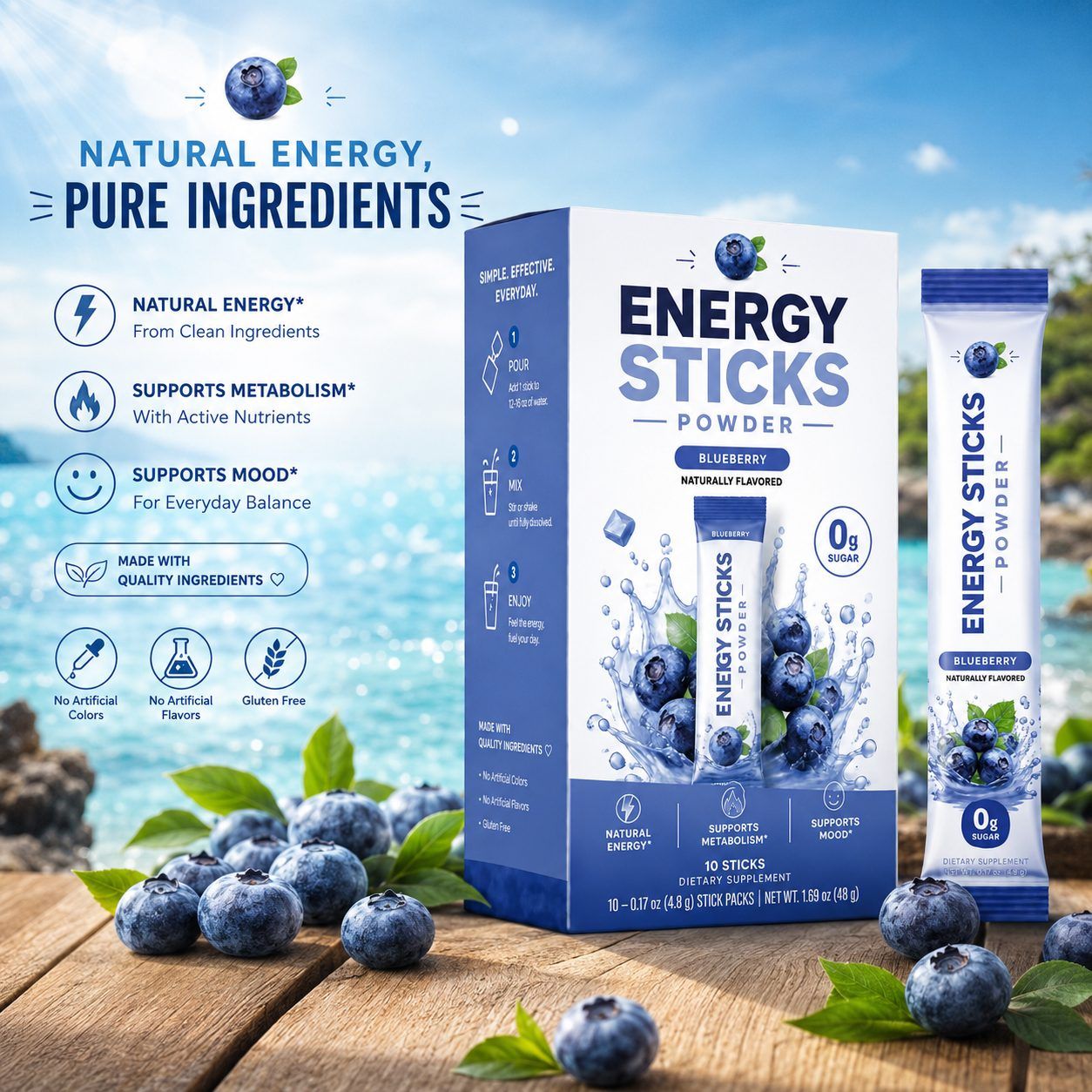
That constraint is also the commercial opportunity in private label energy drink powder. An energy stick is the cheapest way to sell a single-serve caffeinated drink without shipping water, and it is the only format where a brand can put 100 mg of caffeine into a carton that fits through a letterbox. On our powder lines the energy format runs on automatic vertical form-fill-seal equipment, ten sticks to a carton, and the cost structure is dominated by components most first-time buyers never ask about.
The 4.8 gram mass budget, line by line
Below is a working budget for a 100 mg caffeinated energy stick with a 120 mg electrolyte blend and a B-complex top-up. The ranges are typical of commercial formulas rather than a specification. What matters is the proportion, because every gram added to one line has to come out of another.
| Component | Typical load | Share of stick | Job it does |
|---|---|---|---|
| Bulking agent (maltodextrin, erythritol, dextrose) | 2.5-3.2 g | 52-67% | Carries volume, gives the reconstituted drink body, lets the filler hit weight |
| Acid system (citric, malic) | 0.4-0.7 g | 8-15% | Sets pH 3.0-3.4 so fruit flavours read bright |
| Flavour (spray-dried or encapsulated) | 0.35-0.6 g | 7-12% | The single largest variable cost in the stick |
| Electrolyte blend (sodium, potassium, magnesium) | 0.1-0.3 g | 2-6% | Functional claim, but also a bitterness source |
| Caffeine | 0.08-0.15 g | 1.7-3.1% | The only line the consumer can feel |
| Sweetener (stevia, monk fruit, sucralose) | 0.05-0.15 g | 1-3% | Covers the acid and the caffeine |
| Vitamins and minerals | 0.02-0.05 g | 0.4-1% | B-complex at label claim, usually via premix |
| Anti-caking and flow agent | 0.02-0.05 g | 0.5-1% | Keeps powder moving and stops caking in the stick |
| Colour | 0.005-0.02 g | under 0.5% | Beet root, turmeric or spirulina for a clean label |
Two lines in that table decide whether an energy project is viable. Acid, flavour and sweetener together are roughly a fifth of the stick, and those same three ingredients are the most expensive per gram after the packaging film. Caffeine at 100 mg occupies under three percent of the mass but is the only component with an immediate, felt effect. That mismatch is the whole energy business: you pay for flavour and packaging, and you sell caffeine and convenience.
The chart is an index, not a quote, but the ranking holds across suppliers. The flavour system and the stick film together take about half the finished cost. Caffeine, the ingredient on the front of the box, sits near the bottom of the list. A buyer who spends a week negotiating caffeine price has moved a line worth seven percent of the energy stick. A buyer who takes flavour load from twelve percent down to eight percent has moved a line nearly three times larger, and improved the mouthfeel at the same time.
Caffeine is the cheapest ingredient in an energy stick
Caffeine anhydrous trades in the low tens of dollars per kilogram depending on grade and origin, so a 100 mg dose costs roughly one to two tenths of a cent. Natural caffeine from green tea or guarana runs three to five times that, which still leaves the difference per stick under half a cent. This is worth stating plainly because caffeine is where brand owners expect the cost to be. It is not. The cost is in the flavour house invoice and the film roll on every energy SKU.
The form of caffeine matters more for label arithmetic than for price. Caffeine monohydrate carries about 8.5 percent water of crystallisation, so a 100 mg claim built on the monohydrate needs 109 mg of weighed powder. That error is invisible at bench scale and shows up as a failing assay at release. Anhydrous is the default for energy powder sticks for exactly this reason, and it is also the form that dissolves fastest: roughly 20 mg per millilitre of water at room temperature, so 100 mg disappears in about 5 mL of a 250 mL serving.
| Source | Caffeine content | Cost index | Mass needed for 100 mg | Formulation note |
|---|---|---|---|---|
| Caffeine anhydrous | 98-99% | 1.0 | about 101-102 mg | Cheapest per milligram, fully bitter, declares simply as caffeine |
| Caffeine monohydrate | 91-92% | 1.1 | about 109 mg | The hydrate water is part of the weighed mass, not the claim |
| Green tea extract | 50-98% by grade | 2.5-4.5 | 105-200 mg | Carries polyphenols and colour; turns astringent at high load |
| Guarana extract | 10-22% | 3.0-5.0 | 450-1,000 mg | Low density means the extract eats 10-20% of the stick |
| Matcha powder | 2-4% | 4.0-6.0 | 2.5-5 g | Whole-leaf powder; 3 g delivers 60-120 mg and most of the budget |
| Yerba mate powder | 1-2% | 5.0+ | 5-10 g | Cannot reach 100 mg inside a 4.8 g stick at all |
Guarana and yerba mate look attractive on a label and are brutal inside a small stick. Guarana at 10 to 22 percent caffeine needs 450 to 1,000 mg of extract to reach 100 mg, and most of that mass is fibre and tannin rather than caffeine. Yerba mate is worse: at 1 to 2 percent caffeine it needs 5 to 10 grams, which is more than the entire stick. Matcha only works in an energy stick if you accept a lower claim, and 3 grams of it takes 60 percent of the budget before you have added acid, flavour or sweetener.
A 6 microgram vitamin B12 dose is 0.000125 percent of a 4.8 gram stick. No production scale resolves that, so the vitamin arrives as a 1 percent or 0.1 percent trituration on a carrier. Ask which carrier, because a maltodextrin premix counts toward the carbohydrate line on your panel. Ask for the premix certificate too: B12 is one of the few places where a supplier substitution changes both the assay and the printed label.
Taste engineering is where an energy powder is won
Most people detect caffeine bitterness in water somewhere around 100 to 200 mg per litre. A 100 mg stick made up in 250 mL is 400 mg per litre before any other bitter component is added, and an energy formula adds several. Potassium chloride and magnesium salts are bitter, vitamins B1 and B6 are bitter, and green tea or guarana extracts bring astringency on top. You cannot remove that bitterness. You can only outrun it with acid, sweetness and aroma, in that order of importance.
The acid is not decoration
An energy drink mix needs a pH around 3.0 to 3.4 for two reasons: fruit flavours read as bright only in acid, and the microbiological stability of the reconstituted drink depends on it. Citric acid at 0.4 to 0.7 g per stick gets you there. Malic acid sharpens the front of the profile and is what makes sour fruit flavours work. Over-acidify and the stevia aftertaste turns metallic; under-acidify and the drink tastes like flat syrup no matter how much flavour you add.
Sweetener choice moves cost more than flavour choice
Stevia leaf extract is not one ingredient. Reb A at 60 percent purity costs a fraction of Reb M at 95 percent, and the difference is not only price. Reb M is markedly less bitter at the loadings a 4.8 gram stick needs, where sweetener can be 2 to 3 percent of the mass to cover 12 percent acid plus caffeine. On a 100,000-stick energy run, moving from Reb A to Reb M can add four figures to the raw material bill. It is often still the right call, but it should be a decision rather than a default.
The same logic applies to flavour load. A natural flavour at 8 percent of stick weight is 0.38 g; at 12 percent it is 0.58 g. That extra 0.2 g has to come out of bulking agent, which thins the mouthfeel, or out of acid, which flattens the profile. In practice you trade body for aroma. Buyers who ask for a stronger flavour without saying which line should give way are asking the formulator to guess, and the guess usually lands on mouthfeel.
What actually goes wrong on an energy stick line
Energy stick filling is less forgiving than bottle or capsule filling because the package is formed, filled and sealed in one continuous cycle at 40 to 80 strokes per minute. The failures repeat across energy projects:
- Fill weight drifts before it alarms. A plus or minus 2 percent tolerance on 4.8 g is roughly 0.1 g, which is 2 mg of caffeine at a 100 mg dose and perfectly acceptable. On a 6 microgram vitamin it is meaningless, which is why micro-dosed actives must arrive pre-diluted.
- Seal contamination is the most common leak source. A few milligrams of powder in the seal zone at 140 to 160 degrees Celsius creates a channel that fails in transit rather than on the line, so inline vision inspection matters more than end-of-line sampling.
- Static moves light powders. A blend at 0.4 to 0.6 g per millilitre is mostly air by volume, and without grounding and ionisation the fines cling to the former and skew the fill weight.
- Film barrier decides shelf life in tropical markets. A three-ply foil laminate below 0.1 g per square metre per day of water vapour transmission keeps a hygroscopic sweetener from caking; a metallised film at ten times that rate will not survive a Gulf summer.
- Flavour fades before the assay does. Spray-dried flavours lose top notes over 12 months, so a 24-month shelf life usually needs an encapsulated flavour or an overage agreed in writing with the flavour house.
- Colour migrates. Beet root at 0.1 percent is stable in a dry powder but bleeds into the seal area and reads as a defect under inspection light.
- Caking starts around 60 percent relative humidity. Silicon dioxide at 0.5 to 1 percent buys time; it does not replace a proper foil barrier.
- Changeover residue is a real risk. A caffeine blend leaves fines in the feed screw, and the next non-caffeinated SKU on the same line can pick up a measurable carryover unless the line is stripped and cleaned between runs.
- Carton count is verified by weight, not by eye. Ten sticks at 5.1 g against a 4.8 g target is a 6 percent error that only a checkweigher catches before the pallet ships.
Matching an energy label to the market you sell into
Caffeine is treated as a food ingredient rather than a drug in most markets, but the labelling triggers differ enough that one English carton rarely works everywhere. Four rules cover most of what a brand needs at launch.
| Rule | What it says | What it means for an energy stick |
|---|---|---|
| US daily guidance | 400 mg per day is the FDA level not generally associated with adverse effects in healthy adults | A 100 mg stick is a modest single serving; two a day stays inside the guidance |
| EU warning trigger | Beverages above 150 mg per litre must carry the high caffeine content warning, including the advice against children and pregnant or breast-feeding women, in the same field of vision as the name | One stick in 250 mL is 400 mg per litre, so the warning applies even at 100 mg |
| EU alertness claim | The authorised claim that caffeine contributes to increased alertness and improved concentration carries a condition of 75 mg per serving | 100 mg satisfies it with margin, but only if the wording is the authorised wording |
| EFSA safety opinion | Single doses up to 200 mg and daily intake up to 400 mg do not raise safety concerns for healthy adults | Sets a practical ceiling for a single-serve stick and for a two-stick serving |
| Canada and the Gulf | Canada treats caffeine as a medicinal ingredient with its own monograph and bilingual labelling; GCC markets generally require Arabic on the primary panel and expect halal certification at retail | Both need a separate carton, so budget the second artwork before the first print run |
The full framework, including cGMP documentation and halal certification, is set out in our regulations guide. The practical consequence for an energy powder is that the carton, not the formula, is usually the thing that delays a launch.
Stick, tub, can, capsule: what each format costs you
Energy format decisions get made on shelf appeal and then paid for in freight. The comparison below uses a 30-day supply as the basis, because price per unit across formats is meaningless when the serving count differs.
| Format | Caffeine per serving | Relative cost per serving | Freight profile | Where it wins |
|---|---|---|---|---|
| Energy stick pack, 4-6 g | 80-150 mg | 100 | Light but bulky; high cube per serving | Sampling, subscription, travel and marketplace listings |
| Tub with scoop, 300-500 g | 100-200 mg | 70-85 | Heavy per unit, low cube per serving | Gym retail and value positioning |
| Ready-to-drink can, 250-355 mL | 80-160 mg | 140-190 | Water weight dominates the container | Impulse purchase from a chiller |
| Capsule, 2 per serving | 100-200 mg | 55-75 | Dense; cheapest format to ship | Positioning as a supplement rather than a drink |
| Gummy, 2 pieces | 60-100 mg | 110-150 | Moderate; heat-sensitive in transit | Flavour-led brands and impulse ranges |
For an energy brand, a capsule is the cheapest way to deliver caffeine and the worst way to sell an experience. A can is the most expensive per serving and the easiest to sell from a fridge. The energy stick sits between them and wins on a specific combination: it ships without water, it doses precisely, and it reads as a product rather than a pill. That is why energy brands with a direct-to-consumer or subscription model gravitate towards it, and why the same brand often keeps a tub for repeat buyers and an energy stick for acquisition.
Five energy positions, five different formulas
Private label energy drink powder is not one product. The word energy covers at least five shelf positions, each of which pulls the formula in a different direction, and the position has to be settled before the flavour is briefed. The table below shows why the stick weight cannot be fixed in advance: a pre-workout dose of beta-alanine alone will not fit in 4.8 grams.
| Position | Core actives per serving | Taste challenge | Realistic stick weight |
|---|---|---|---|
| Clean energy | Caffeine 80-120 mg from green tea, vitamins B6 and B12 | Green tea astringency once the extract passes 150 mg | 4-5 g |
| Pre-workout energy | Caffeine 150-200 mg, beta-alanine 1.6-3.2 g, citrulline 3-6 g | Beta-alanine tingling is expected; the bitterness is severe | 8-14 g |
| Hydration energy | Caffeine 60-100 mg plus 300-500 mg electrolyte blend | Potassium and magnesium salts fight every fruit flavour | 5-7 g |
| Coffee replacement | Caffeine 100-140 mg from matcha or instant coffee | Roast notes need a cream flavour or the acid reads sour | 5-8 g |
| Nootropic energy | Caffeine 80-100 mg, L-theanine 100-200 mg, B vitamins | L-theanine is mild but umami, which flattens fruit top notes | 4-6 g |
That table explains most of the reformulation requests we see. A brand builds a 4.8 gram clean energy stick, then adds beta-alanine and citrulline for a pre-workout variant and discovers the actives alone need 8 grams. The stick has to grow, and a bigger stick means a new film width, a new carton and a new fill target. Deciding the position first is cheaper than discovering it at sample stage.
MOQ, lead time and what to send us
Standard terms for private label energy drink powder are a 1,000-unit minimum, pre-production samples in 7 to 10 days, production in about 15 working days after material release, and a 24-month shelf life supported by stability data. A stock energy stick and a stock carton can be printed and filled at that minimum. A custom flavour, a custom film print and a custom carton realistically land at 3,000 to 5,000 units, because the flavour house and the printer carry their own minimums and you pay for them either way.
The arithmetic behind that step is in our MOQ and lead times guide, and the way fixed costs spread across a first run is broken down in the unit cost guide. If the flavour and solubility side is new to you, the powder manufacturing guide covers mesh size and dispersion in detail.
What speeds a private label energy drink powder quote up is a short, specific brief: the caffeine dose and source; the target serving volume, because 250 mL and 500 mL need different acid and sweetener loads; the electrolyte blend and whether it is declared on the panel; the vitamin list with the exact forms; the sweetener system you will accept; the carton count; and the first market you are launching in. Send those seven and the quote comes back with its assumptions attached, instead of a number you have to reverse-engineer.
Two existing products are useful references while you brief: the electrolyte powder stick, a 7.6 g single-serve format with a published ingredient list, and the matcha green tea powder, which is the natural-caffeine route if you want the source named on the front of the pack. Both sit inside the powder range, alongside creatine monohydrate for brands building a performance stack rather than a single energy SKU.
Want your private label energy drink powder costed line by line?
Send the caffeine dose, the serving volume, the electrolyte and vitamin list, the sweetener system you will accept, and your first market. We will come back with a mass budget, a film and carton specification, and a quote that states its MOQ and lead time.
What decides an energy powder project
- Private label energy drink powder starts with a closed 4.8 g mass budget: every gram of flavour or electrolyte has to come out of the bulking agent or the acid.
- In an energy stick, caffeine is one to three percent of the mass and roughly seven percent of the cost; flavour and film together are about half.
- Caffeine monohydrate is only 91 to 92 percent caffeine, so a 100 mg claim needs about 109 mg of weighed powder.
- Most people detect caffeine bitterness at 100 to 200 mg per litre, and a 100 mg energy stick in 250 mL is 400 mg per litre.
- Reb M instead of Reb A is the single most reliable way to fix stevia bitterness, and it is a cost decision, not a default.
- A 1,000-unit minimum works on stock components; custom flavour, film print and carton realistically start at 3,000 to 5,000 units.
References
- US FDA - Dietary supplements overview
- 21 CFR Part 111 - Current good manufacturing practice for dietary supplements
- EFSA - Scientific opinion on the safety of caffeine (2015)
- EU Regulation 1924/2006 - nutrition and health claims, Annex III caffeine labelling
- EU Register of nutrition and health claims - caffeine and alertness
Key takeaways
- Private label energy drink powder starts with a closed 4.8 g mass budget: every gram of flavour or electrolyte has to come out of the bulking agent or the acid.
- In an energy stick, caffeine is one to three percent of the mass and roughly seven percent of the cost; flavour and film together are about half.
- Caffeine monohydrate is only 91 to 92 percent caffeine, so a 100 mg claim needs about 109 mg of weighed powder.
- Most people detect caffeine bitterness at 100 to 200 mg per litre, and a 100 mg energy stick in 250 mL is 400 mg per litre.
- Reb M instead of Reb A is the single most reliable way to fix stevia bitterness, and it is a cost decision, not a default.
- A 1,000-unit minimum works on stock components; custom flavour, film print and carton realistically start at 3,000 to 5,000 units.
Frequently asked questions
What is the minimum order quantity for a private label energy drink powder?
Standard production starts at 1,000 units when the stick film and the carton are stock components, which is enough for a pilot launch and a first marketplace listing. A custom flavour, a custom-printed film and a custom carton move the practical minimum to 3,000 to 5,000 units, because the flavour house and the printer have their own run minimums. Samples take 7 to 10 days and production about 15 working days after material release.
How much caffeine should one energy stick contain?
Most commercial sticks sit between 80 and 150 mg. A 100 mg stick is a reasonable default: it satisfies the EU authorised alertness claim, which requires 75 mg per serving, and two sticks a day stays inside the 400 mg daily level the FDA and EFSA associate with no safety concern in healthy adults. Above 150 mg per serving you also cross additional labelling triggers in several markets.
Why does my energy powder taste bitter even with a strong flavour?
Flavour masks aroma, not bitterness. A 100 mg caffeine dose in 250 mL is about 400 mg per litre, roughly two to four times the level at which most people detect caffeine bitterness, and potassium chloride, magnesium salts and vitamins B1 and B6 add more. The fix is usually more acid, a less bitter sweetener such as Reb M, and a small amount of salt or cream flavour to round the finish, rather than a larger flavour load.
Can the formula use only natural caffeine?
Yes. Green tea extract at 50 to 98 percent caffeine is the most practical natural source inside a small stick, and it also gives a label story. Guarana at 10 to 22 percent caffeine needs 450 to 1,000 mg of extract for a 100 mg dose, which consumes 10 to 20 percent of a 4.8 g stick. Yerba mate at 1 to 2 percent cannot reach 100 mg in that mass at all. Expect natural caffeine to cost three to five times the synthetic grade.
Can you produce a caffeine-free version of the same formula?
Yes, and it is usually the second SKU rather than a separate development. Removing 100 mg of caffeine frees about two percent of the stick, which you reallocate to bulking agent and a little more acid, because caffeine contributes bitterness that the acid was balanced against. The film and carton can stay identical apart from the panel, which keeps the print run and the changeover cost down.
How stable is an energy powder in a stick pack?
With a three-ply foil laminate and a water vapour transmission rate below 0.1 g per square metre per day, a 24-month shelf life is achievable and is what we support with stability data. The limiting factors are usually flavour top notes and hygroscopic sweeteners rather than caffeine, which is stable in a dry matrix. In hot and humid markets, ask for the film specification in writing before approving artwork.
Have a project in mind? We'll come back with MOQ, formula options and lead time within 24 hours.
Request a Quote