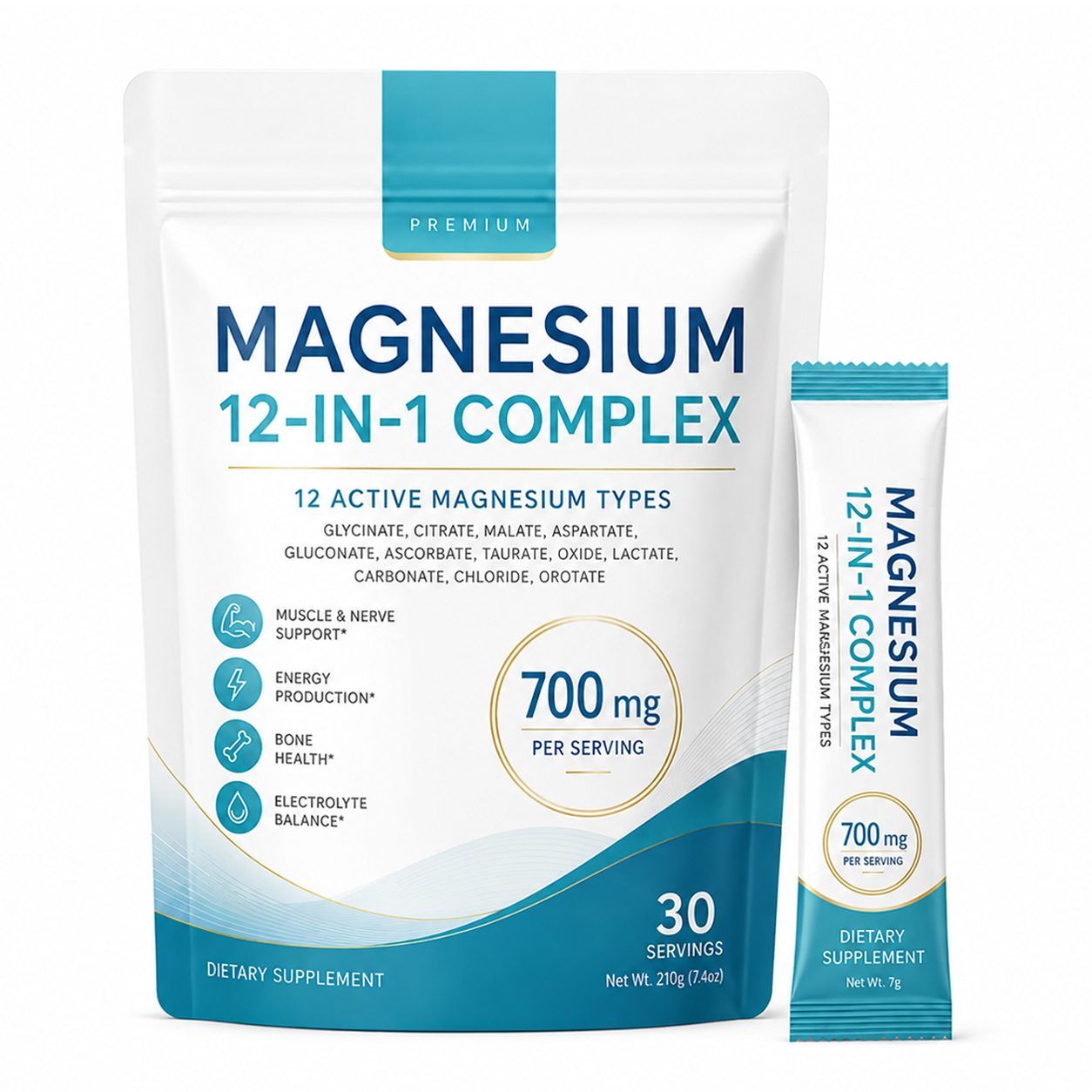
Almost every private label magnesium brief reaches a factory the same way. A brand owner screenshots a competitor listing and asks us to match the number printed on the front of the bottle. That number is rarely comparable to anything. One label reads Magnesium 500 mg. Another reads Magnesium Glycinate 500 mg. The first states elemental magnesium. The second states the weight of a compound that is only about 14 percent actual mineral, so it promises roughly 70 mg of the element while charging a premium price. Answering the wrong version of that question sets a project up to fail at the costing stage, or worse, at the label review.
Magnesium is a required nutrient with a US Daily Value of 420 mg for adults, which is why the elemental figure is the one regulators, the Supplement Facts panel and informed buyers all read. It is also the figure that decides whether your dose fits a capsule, a tablet, a stick pack or a gummy. This guide walks through the arithmetic we run before we accept a magnesium project, and the four places where that arithmetic usually breaks.
One mineral, six formats, six different ceilings
Magnesium is not a niche mineral for a supplement factory. It appears in sleep and relaxation formulas, muscle and cramp products, bone and multi-mineral blends, hydration powders, cognitive nootropic stacks, prenatal ranges and even effervescent hydrogen tablets. Because the same mineral slot opens in so many concepts, a single 300 mg elemental dose is sold in at least six formats, and each format imposes its own physical ceiling on how much of the element can be delivered per serving.
The most common starting point is a multi-source tablet, because compression is the only dry format where a 300 mg elemental claim stays small enough to swallow comfortably. Our own magnesium complex tablets deliver 300 mg of magnesium per 2-tablet serving from citrate, glycinate and oxide salts, 90 tablets to a bottle and 45 servings per container.
Elemental magnesium is the only comparable number
Magnesium never travels alone. It is bound to an oxide ion, a citrate molecule, two glycine molecules or a threonate ligand, and the carrier contributes most of the weight on the certificate of analysis. Elemental magnesium is the fraction that is genuinely the element, and it is the figure that belongs in your Supplement Facts panel. Two products compared on any other basis are being compared on packaging.
| Magnesium form | Elemental Mg | Raw material for 100 mg Mg | Absorption evidence | Bowel tolerance |
|---|---|---|---|---|
| Oxide | 60.3% | About 166 mg | Low; roughly 4% in older balance studies | Laxative at higher doses |
| Hydroxide | 41.7% | About 240 mg | Low; osmotic action | Used as an occasional laxative |
| Carbonate | 28.8% | About 347 mg | Low; acid-dependent | Antacid behaviour |
| Citrate | 16.2% | About 619 mg | Good | Laxative above roughly 400 mg |
| Malate | 15.5% | About 652 mg | Good | Generally gentle |
| Bisglycinate | 14.1% | About 709 mg | Good | Gentlest common form |
| Chloride | 12.0% | About 833 mg | Good | Moderate |
| Taurate | 8.9% | About 1,124 mg | Good; limited human data | Gentle |
| L-threonate | 8.3% | About 1,205 mg | Moderate; patented forms are better studied | Gentle |
| Gluconate | 5.4% | About 1,852 mg | Good | Used in paediatric liquids |
Read the third column as a purchasing instruction. A 100 mg elemental claim costs you either 166 mg or 1,852 mg of powder depending on the form you name on the panel. That is an eleven-fold difference in the material that has to be blended, tested, transported and paid for, for the same declared potency. Once the claim climbs to 300 mg, the same spread becomes the difference between a small tablet and a serving of four capsules.
A label reading Magnesium Glycinate 500 mg promises 500 mg of compound, which is about 70 mg of elemental the element. A label reading Magnesium 500 mg promises 500 mg of elemental magnesium, which needs roughly 3,500 mg of bisglycinate. Confirm which figure a client means, in writing, before a formula or a Supplement Facts panel is locked.
The fill budget: what each format really holds
Once the elemental yield is known, the next question is physical. A size 00 capsule takes roughly 760 mg of powder at typical bulk density and a size 0 takes about 545 mg. Deduct flow agents, anti-caking agents and the clearance between the powder column and the shell wall, and you lose another 5 to 10 percent of that. Multiply what remains by the number of units in a serving and you have your entire budget. Every magnesium concept has to be designed inside that number.
| Format | Usable fill per serving | Elemental Mg from bisglycinate | Elemental Mg from oxide | Where it wins |
|---|---|---|---|---|
| 2 x size 0 capsule | About 1,000 mg | About 140 mg | About 600 mg | Compact daily mineral |
| 2 x size 00 capsule | About 1,400 mg | About 200 mg | About 840 mg | Full-dose multi-mineral blend |
| 2 x compressed tablet | About 2,400 mg | About 340 mg | About 1,450 mg | 300 mg and above elemental claims |
| 2 x softgel, suspension fill | About 2,000 mg | Requires a paste fill | Requires a paste fill | Calcium, magnesium and zinc together |
| 7 g stick pack powder | About 6,500 mg | About 900 mg | About 3,900 mg | Flavoured 300 mg and above drinks |
| 2 x pectin gummy | About 4,500 mg base | About 50 mg practical ceiling | About 50 mg practical ceiling | Taste-led low dose |
The gummy row deserves a warning, because it is the format most often mis-briefed. Bulk is not the constraint there; bitterness is. Magnesium salts read metallic and chalky on the tongue, and that bitterness becomes noticeable long before the gummy base runs out of capacity. It is why almost every commercial gummy in this category lands between 20 and 50 mg of the element per serving no matter how large the piece is, and why the mineral usually arrives in a sleep gummy as a supporting ingredient rather than a headline dose. Our melatonin and L-theanine gummies carry 30 mg of magnesium from magnesium citrate per 2-gummy serving, which is an honest ceiling for a pleasant-tasting pectin gummy.
The complex trap: how oxide rescues a label that promised too much
Multi-form complexes are the fastest-growing private label magnesium format and the easiest to get wrong. The pitch is that different forms reach different tissues and widen the funnel. The physiology is less generous. The mineral is absorbed mainly in the small intestine through saturable active transport channels, with passive paracellular diffusion taking over at higher intakes. Every salt ultimately dissociates and competes for those same routes, and fractional absorption is well documented to fall as a single dose rises. Dividing 300 mg across four carriers does not create four doorways; it creates four invoices.
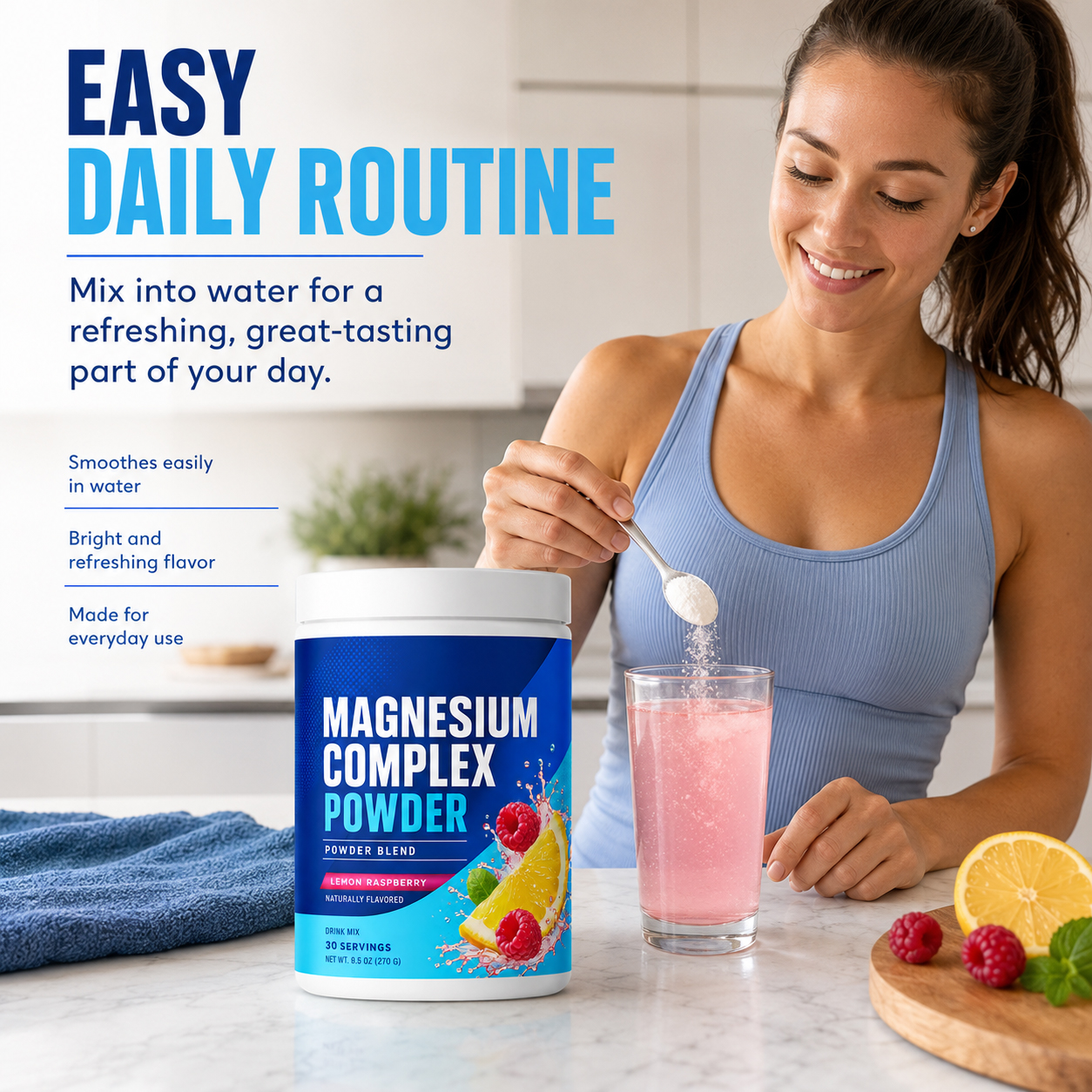
What the split does do, unambiguously, is consume fill weight. Here is the arithmetic for a genuine 300 mg elemental dose built from the four forms we use in our flavoured powder blends, compared against the single-form shortcuts.
| Approach | Raw material per serving | Elemental Mg delivered | What breaks |
|---|---|---|---|
| Oxide only | About 500 mg | 300 mg | Smallest and cheapest, but absorption is poor and the dose is laxative |
| Bisglycinate only | About 2,130 mg | 300 mg | Needs 3 to 4 size 00 capsules per single serving |
| Citrate, glycinate, malate and taurate, split evenly | About 2,320 mg | 300 mg | Fits a 7 g stick pack, never a capsule or a small tablet |
| Six-form premium complex | About 2,100 mg | 250 mg | Either 8 capsules a day, or a token dose of premium forms beside bulk oxide |
| Citrate, glycinate and oxide tablet | About 1,250 mg | 300 mg | Oxide silently supplies most of the number while the label still reads three forms |
Look at the last row honestly, because it explains most of the private label magnesium category. Oxide is dense enough in the element to rescue an ambitious claim inside a swallowable tablet. That is why oxide appears near the top of so many premium complex ingredient lists. It is not evidence of a badly built formula; it is the physics of the format. The useful question to put to a manufacturer is how the elemental figure splits across the named forms in milligrams, and whether each premium form is present at a level worth naming at all.
Reading a real label: where 1,500 mg of powder actually goes
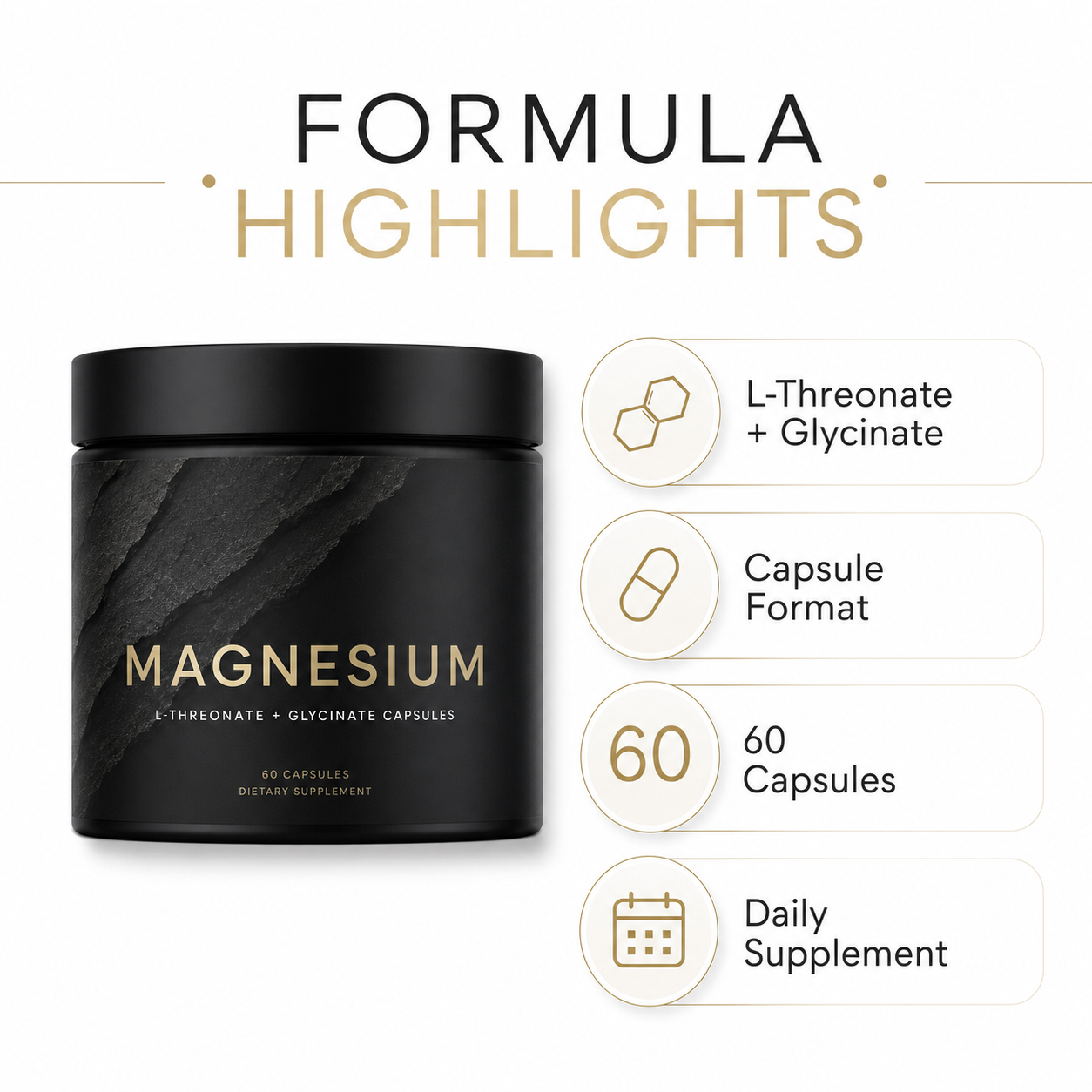
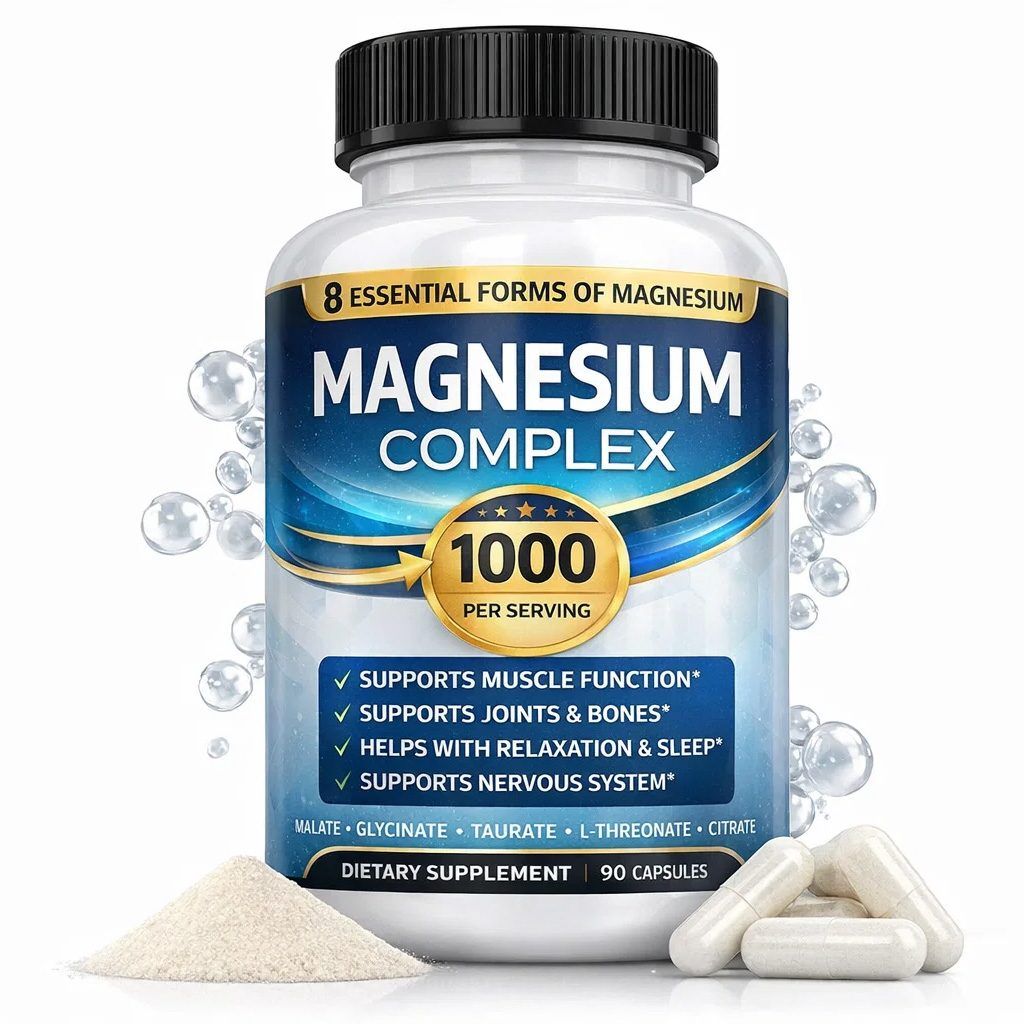
Our own magnesium L-threonate and glycinate capsules are a useful case study. Two capsules deliver 120 mg of elemental magnesium, carried by a 1,000 mg L-threonate blend and a 500 mg glycinate blend. That is roughly 1,500 mg of material, close to the practical limit of two size 00 shells, and only about 8 percent of it is actually magnesium. Nothing is wrong with the product. It is simply what threonate chemistry costs in volume.
Taste, moisture and the excipients nobody reads out loud
Three manufacturing details decide how a private label magnesium product behaves on the line and in the mouth, and none of them appear in a brief that was written from a competitor listing.
- Bitterness, not solubility, caps gummy and chewable doses. Magnesium salts read metallic before the base runs out of capacity, so plan for 20 to 50 mg elemental per serving and test early.
- Citrate and glycinate are hygroscopic. Specify loss on drying, keep raw material in sealed drums and use a desiccant in the bottle, or expect caking and softening in transit.
- On a rotary press these salts are poorly compressible. Expect granulation, a denser diluent system and a slower turret speed, all of which move the tablet cost line.
- Magnesium stearate at 0.5 to 2 percent is a flow lubricant, not a mineral source. It contributes no meaningful elemental magnesium to the number on your panel.
- Consumers now search for magnesium stearate free. If you remove it, plan to solve for sticking and weight variation with silica or an extra granulation step instead.
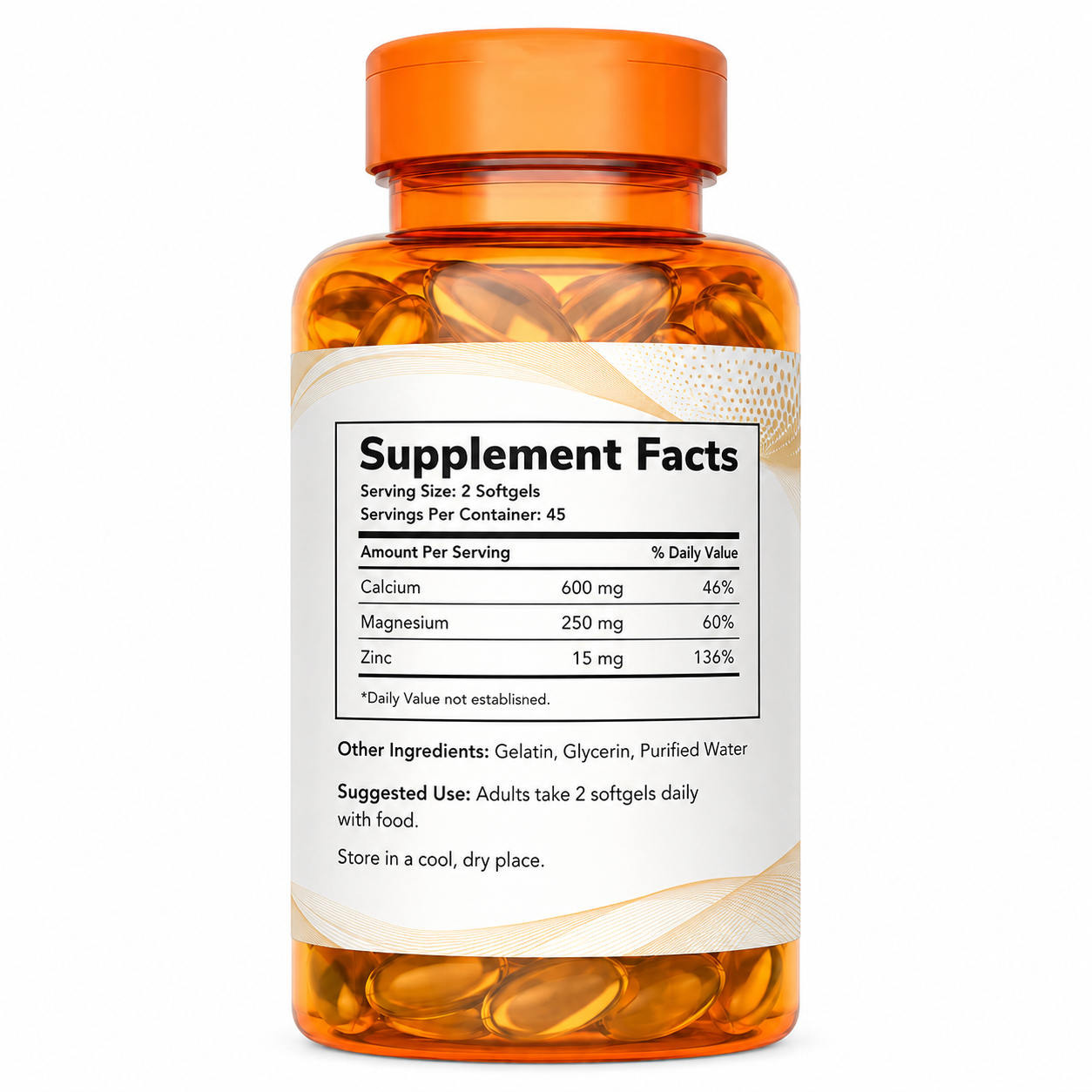
- In softgels, magnesium has to arrive as a suspended paste rather than a dry powder, which is how two softgels can carry 250 mg of magnesium alongside calcium and zinc.
- Acidic flavour systems mask the metallic note well, but they also increase moisture uptake in a powder. Match the acid level to your stick pack barrier before approving a prototype.
- Effervescent formats are their own science. Magnesium citrate in a dissolve-in-water tablet cannot climb far past a few hundred milligrams before the tablet becomes too large or too slow to dissolve.
- Blend uniformity is the quiet risk. An elemental assay runs on a few grams, so a 30 kg blend containing a minor ingredient needs a documented mixing validation, not an assumption.
- Every format needs its own shelf-life data. A 24-month claim on a hygroscopic powder will not transfer automatically to a gummy built from the same actives.
Softgels are the exception that proves the volume rule. Our calcium magnesium zinc softgels deliver 600 mg of calcium, 250 mg of the mineral and 15 mg of zinc in a 2-softgel serving, 90 softgels to a bottle. It works because the mineral arrives as a suspended paste rather than a dry powder, and because three minerals share one fill instead of competing for their own shells.
Liquids sidestep the fill problem entirely, which is why magnesium glycinate turns up in dropper formats such as our L-theanine liquid drops, a 60 mL formula carrying the chelate alongside GABA, vitamin B6 and chamomile. A calibrated dropper can deliver a small elemental dose with no compression, no shell and no gummy base. The trade is a preservative system, tighter stability work and a bottle that costs more per serving than a capsule.
What testing actually proves
A private label magnesium certificate of analysis is not a marketing document, and a multi-form blend is where weak documentation shows up first. For each source, ask for the elemental assay method rather than the result alone, since titration and ICP-OES answer different questions and only one of them resolves a blend. Ask for identity confirmation, individual heavy metals results rather than a single total figure, microbiology against the limits of your target market, and moisture on any hydrate form. A factory certificate naming ISO 22000 or cGMP tells you that a quality system has been audited. It does not tell you that your batch met your specification. That is what the lot certificate and your own incoming identity test are for.
Cost per absorbed milligram, not cost per kilogram
Magnesium raw materials span an unusually wide price band, and price per kilogram is the least useful number in the file. What matters commercially is the cost of the raw material you must buy to deliver one serving's elemental dose.
| Magnesium form | China bulk reference (USD/kg) | Raw material for 150 mg Mg | Relative material cost per serving |
|---|---|---|---|
| Oxide | $1.80 to $5.50 | About 249 mg | Baseline, approximately 1x |
| Citrate | $6 to $10 | About 926 mg | Roughly 6 to 10x |
| Malate | $12 to $20 | About 968 mg | Roughly 14 to 20x |
| Bisglycinate | $18 to $28 | About 1,064 mg | Roughly 22 to 32x |
| Taurate | $20 to $35 | About 1,685 mg | Roughly 40 to 60x |
| L-threonate, unbranded | $35 to $55 | About 1,807 mg | Roughly 70 to 110x |
Read down the last column and the strategic decision makes itself. Moving from oxide to unbranded L-threonate multiplies raw material cost per serving by roughly 70 to 110 times while delivering exactly the same 150 mg of the element. That premium can be justified by positioning, by a branded ingredient with its own trial data, or by genuine tolerance differences at high doses. What it cannot survive is being discovered when the first costing sheet lands. This is also the honest explanation for the micro-dose pattern in premium complexes: oxide carries the number, and the expensive forms appear at a token level. Neither approach is cheating, but a buyer deserves to know which one they are paying for.
Want the elemental split for your private label magnesium concept?
Send us your target elemental dose and the forms you are considering. We will come back with a format recommendation, the elemental split in milligrams, MOQ and lead time, usually within 24 hours.
MOQ, lead time and what to lock first
Private label magnesium projects are rarely delayed by the mineral. They are delayed by the packaging and by granulation, both of which sit outside the formula approval everyone focuses on.
- Our standard minimum is 500 units per product. At a 60-count bottle that is 30,000 filled units, enough for the line to hold weight variation tight without demanding a large first order.
- Stock packaging keeps you at the MOQ floor. Custom bottles, desiccant canisters and printed cartons each add a cycle and a setup charge.
- Standard production runs about 15 days once materials are released, and about 10 days expedited. The clock starts on materials, not on formula approval.
- Granulation adds roughly one to two weeks and is the single most common surprise on a high-dose mineral tablet.
- Order the shell, the bottle and the desiccant before production starts, not after the formula is signed.
- Lock the flavour and the acid level before stability testing begins, because changing either one invalidates the stability data you have just paid for.
Lead time behaves differently in supplement manufacturing than in most other contract industries, so it helps to see how MOQ and lead times are really structured before briefing a factory. If your concept is capsule-based, the size decision belongs in the same conversation, and our capsule size and fill weight guide walks through that volume maths in detail. If the format is still open, compare all six side by side in our dosage form comparison first, because changing format after a formula is approved is the most expensive revision available.
Compliance: what can and cannot go on the panel
Magnesium is an established nutrient with a defined daily value, so most magnesium claims are structure-function statements that require the standard disclaimer and must stop short of disease language. In the United States that structure is set out for dietary supplements in 21 CFR 101.93. In the European Union the same words are governed by the health claims register, where most magnesium claims are authorised only against a defined contribution to the daily reference intake. Two practical consequences follow. First, your elemental dose has to be high enough to support the claim you want in each target market, which is frequently a tighter constraint than the fill budget. Second, one formula will usually need different label copy per market, so plan the regulatory review as a cost line and not as a formality.
Our overview of FDA, cGMP and Halal requirements covers the documentation a factory should be able to hand you at the quotation stage, including the certificates that matter for a mineral product.
None of this is exotic chemistry, and none of it requires a new supply chain. It requires deciding the elemental target first, choosing the format by the fill budget second, and pricing the raw material per serving rather than per kilogram before anyone approves artwork.
Five decisions to make before briefing a factory
- State the elemental magnesium target in milligrams, not compound weight. The two differ by as much as eleven times for the same declared potency.
- Choose the format by the fill budget: about 1,400 mg in two size 00 capsules, about 2,400 mg in two compressed tablets, about 6,500 mg in a 7 g stick pack.
- Decide whether premium forms carry the dose or appear as a token. Ask for the elemental split in milligrams, in writing, before approving the panel.
- Price raw material per serving, not per kilogram. Oxide to unbranded L-threonate moves the material cost by roughly two orders of magnitude.
- Treat taste, moisture and granulation as cost lines. They determine whether a prototype survives scale-up, and they are cheapest to solve at the bench.
Sources
- NIH Office of Dietary Supplements - Magnesium fact sheet for health professionals
- Schuchardt JP, Hahn A - Intestinal absorption and factors influencing bioavailability of magnesium: an update, Current Nutrition and Food Science, 2017
- Firoz M, Graber M - Bioavailability of US commercial magnesium preparations, Magnesium Research, 2001
- US FDA - 21 CFR 101.93, Certain types of statements for dietary supplements
- European Food Safety Authority - Health claims register and authorised magnesium claims
- Industry price reporting for magnesium raw materials, China bulk supply, 2025 to 2026 - released USP and food grade market reference ranges
- Yukang Medicine internal formulation and production records for magnesium SKUs and completed mineral projects
Key takeaways
- Elemental magnesium is the only comparable figure: oxide is 60.3 percent magnesium by weight while bisglycinate is 14.1 percent, so the same declared dose can need 166 mg or 1,852 mg of raw material.
- Format is a fill budget problem first. Two size 00 capsules hold about 1,400 mg of powder, two tablets about 2,400 mg and a 7 g stick pack about 6,500 mg.
- Gummies are limited by bitterness rather than bulk, which is why commercial magnesium gummies sit between 20 and 50 mg of elemental magnesium per serving.
- Mixing five forms does not add absorption routes - all salts compete for the same saturable transport - but it does consume fill weight, and oxide usually ends up carrying the declared number.
- Raw material cost per serving moves by roughly 70 to 110 times between magnesium oxide and unbranded L-threonate, so the form decision is a pricing decision from day one.
Frequently asked questions
What is the difference between magnesium and magnesium glycinate on a label?
The difference is elemental versus compound weight, and it is large. A label reading Magnesium 500 mg states 500 mg of elemental magnesium. A label reading Magnesium Glycinate 500 mg states 500 mg of the compound, which at roughly 14.1 percent elemental content is only about 70 mg of actual magnesium. Two bottles sold at the same price point can therefore differ by more than seven times in delivered mineral. Always confirm which figure a supplier is quoting, in writing, before a Supplement Facts panel is finalised.
How much magnesium can actually fit in a capsule?
It depends on the form, not the shell alone. A size 00 capsule holds about 760 mg of powder and a size 0 about 545 mg at typical bulk density, and you lose another 5 to 10 percent to flow agents and wall clearance. Two size 00 capsules therefore give you roughly 1,400 mg of material, which is about 200 mg of elemental magnesium from bisglycinate or about 840 mg from oxide. That is why high-dose glycinate products need three or four capsules per serving.
Should I choose magnesium oxide or magnesium glycinate?
Choose by the job, then by the budget. Oxide is the densest common form at 60.3 percent elemental and by far the cheapest, but it absorbs poorly and acts as a laxative at higher doses, which suits value positioning and gentle bowel support. Glycinate is bulky and roughly 22 to 32 times more expensive per serving, but it is well tolerated and pairs naturally with sleep and stress concepts. Citrate sits in the middle as the best value per absorbed milligram and is the natural choice for a general repletion product.
Do multi-form magnesium complexes absorb better than a single form?
The evidence for that is weak. Magnesium is absorbed mainly through saturable active transport in the small intestine, with passive diffusion taking over at higher intakes, and every salt dissociates and competes for the same routes. Fractional absorption falls as the single dose rises, so splitting a dose across four carriers does not create four pathways. Complexes still have a commercial role, because they let a brand speak to several consumer interests on one panel, but the benefit is positioning rather than pharmacokinetics.
What is the MOQ for private label magnesium supplements?
Our standard minimum is 500 units per product. At a 60-count bottle that equals 30,000 filled units, which is enough for the line to hold weight variation tight while keeping a first order affordable. Stock packaging keeps you at that floor; custom bottles, printed cartons and desiccant canisters each add setup cost or a lead-time cycle. Standard production runs about 15 days after materials are released, or about 10 days expedited, with granulation adding one to two weeks on high-dose tablets.
Why is my magnesium gummy limited to such a small dose?
Because taste, not volume, is the binding constraint. Magnesium salts taste metallic and chalky, and that bitterness becomes apparent well before the gummy base is physically full. Commercial magnesium gummies therefore almost always land between 20 and 50 mg of elemental magnesium per serving regardless of piece size. If your concept needs 200 mg or more, the honest formats are capsules, tablets or a flavoured powder; if magnesium is a supporting mineral in a sleep or relaxation gummy, 30 mg from magnesium citrate is a realistic and defensible target.
Have a project in mind? We'll come back with MOQ, formula options and lead time within 24 hours.
Request a Quote