Starting a supplement brand looks like a branding problem and behaves like a cash-flow problem. The formula is rarely the expensive part of a launch. The money goes into print plates and dielines, sample rounds and courier fees, third-party panels, freight, and the inventory you have to hold before a reorder lands. This guide is written from the factory side of the table, where we see which first orders survive contact with the market and which ones leave a new brand holding 5,000 units it cannot move.
The order of decisions matters more than the plan itself. Choose the SKU, then the manufacturing route, then the volume, and only then argue about unit price. Brands that shop on price first tend to land on a format whose minimum order they cannot fund, or a label they cannot legally print in the market they intend to sell into. A brand that starts from its own cash position rather than a competitor price list makes better decisions at every later stage.
If the format is still open, our comparison of capsules, tablets, softgels, gummies, powders and liquids weighs each one against MOQ, shelf life and per-serving cost before you commit.
The numbers that decide whether a launch is fundable
A launch budget is not the invoice from the factory. It is every payment between the idea and the first sellable pallet, and the factory invoice is usually only half of it. Most first-time brands budget for the run and forget the plates, the panels and the pallet that has to sit somewhere before it sells. The split below is illustrative for a 1,000-unit powder SKU; use the shares to sanity-check a brand's own spreadsheet rather than as a quotation.
| Line item | Typical share | When it is paid | Where first-time brands underestimate |
|---|---|---|---|
| Formula development or stock formula fee | 3-8% | Before the first batch | Rework after a failed bench sample |
| Samples and courier rounds | 2-4% | Weeks 1-5 | Two or three rounds, at 7-10 days each |
| Artwork, dielines and print plates | 5-12% | Weeks 4-8 | A second flavour needs its own plate set |
| First production run | 50-65% | At purchase order | Ordering more than 90 days of sell-through |
| Release testing and stability | 4-8% | During and after production | A panel per lot, not one panel per year |
| Freight, duty and customs | 8-15% | Before release | Chargeable weight and cube, not invoice value |
| Working capital buffer | 10% | Held back | Reorders fall due before the first order sells out |
The most misunderstood line is the fixed cost hidden inside the production run. A changeover on a powder line and a set of label plates are roughly $800 and $600 in this model. Spread over 1,000 units that is $1.40 per unit; spread over 3,000 units it is $0.47. The $0.93 difference is often larger than the entire raw-material gap between two grades of the same active, which is why volume pricing is arithmetic rather than generosity.
Landed cost is where the budget usually breaks. Powder is light but bulky, so freight is charged on volume rather than weight, and a 1,000-unit order of 300 g pouches can occupy more container space than a 3,000-unit order of capsules. Compare EXW and DDP quotes before choosing a supplier, because the cheaper ex-works price can lose on cube for a brand shipping its first pallet. Our unit price breakdown separates the six cost buckets inside a supplement quote.
Pick one SKU before you pick a manufacturer
If you are about to start a supplement brand, the most common first-order mistake is launching a range. Three SKUs at 500 units each cost more in plates, proofs and testing than one SKU at 1,500 units, and they split the same marketing budget three ways at the moment a brand can least afford it. Pick the single product with the shortest path to a legal label: a stock base, a stock container, one flavour, one count. A 120-count capsule or a 10-stick pouch does that job. A custom gummy does not, because the die, the drying room and the 3,000-unit minimum all arrive before your first sale.
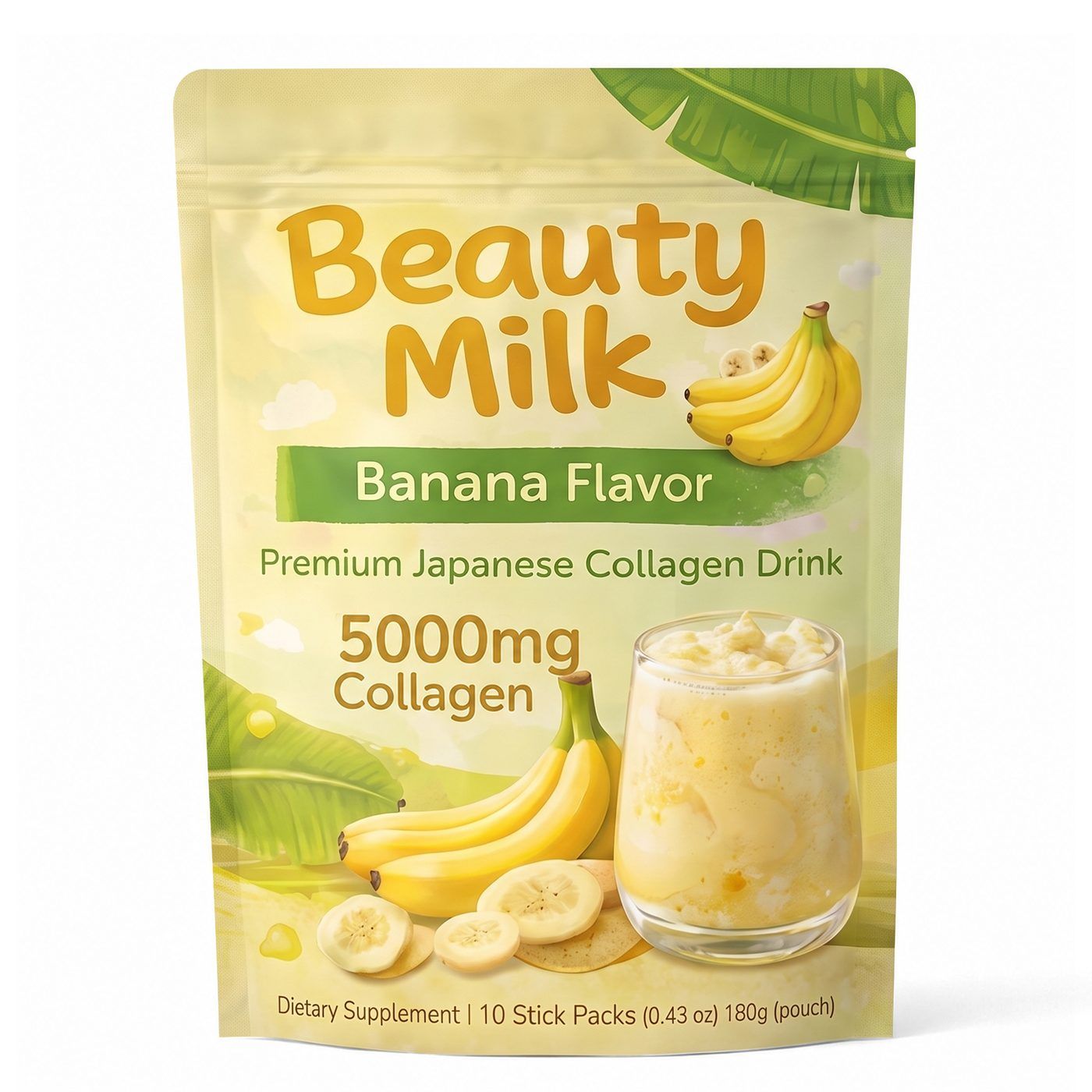
The pouch above is a useful model for a brand's first order. It carries 5,000 mg of collagen peptides in each of ten stick packs, which makes it a ten-serving trial pack rather than a thirty-day tub: lower cash per unit, faster sell-through, and a flavour decision that can be tested before a larger run is committed. The same base runs across six flavours in our library, so a second flavour becomes a print and planning exercise rather than a new formulation project. That difference is usually what separates a range that scales from a range that stalls.
For the costing side of that move, see our line extension guide, which prices a second flavour as a full SKU rather than as a variant of the first.
Stock formula, semi-custom or full custom
There are three ways to get a product, and they differ less in price than in what you are allowed to change later. Stock formulas are the fastest and cheapest entry. Full custom development is the only route when your dose or claim cannot be carried by anything already on the shelf. The middle option, customising a stock base with two or three actives, is where most credible brand launches land.
| Route | What you control | Typical first MOQ | Calendar to first batch | Who owns the formula | Best for |
|---|---|---|---|---|---|
| Stock formula | Flavour, count, label and pack | 500-1,000 units | 3-5 weeks | Manufacturer; shared with other brands | A brand testing a category with minimum cash |
| Semi-custom | Dose of two or three actives, flavour, pack | 1,000-2,000 units | 6-9 weeks | Negotiable, so put it in writing | A brand that needs a defensible label without a new base |
| Full custom | Everything, including the base | 1,000-2,000 after a 300-800 pilot | 7-10 weeks after brief | Contract-dependent, never assumed | A brand whose dose or claim no stock SKU can carry |
White label is not a dirty word, but be clear about what you are buying. A stock blend is sold to other brands, so your differentiation has to come from the parts you control: flavour, pack count, dose disclosure and positioning. A brand that buys a stock formula and then markets it purely on the formula is competing with every other buyer of the same blend. If the formula is the product, pay for exclusivity or commission development, and settle ownership in writing before the first batch.
Two guides go deeper on that decision: private label versus custom contract manufacturing, and who owns the formula. If you are starting from a blank page rather than a stock base, the brief-to-sample process is the realistic timeline.
The MOQ ladder and the cash it locks up
When you start a supplement brand, minimum order quantity is a production constraint before it is a price. A line loses money below a certain batch size because setup, cleaning and QC are fixed, so the first unit off a small run carries all of that cost. For a new brand, the ladder below matters more than any discount: it uses the same fixed-cost model as the budget table, with an illustrative base unit cost of $2.00 before fixed costs.
| Volume | Fixed cost per unit | Unit price index | Cash outlay in finished goods | What it is for |
|---|---|---|---|---|
| 500 units | $2.80 | 128 | $1,280 | Market test, one flavour, no retail listing |
| 1,000 units | $1.40 | 100 | $2,000 | First real launch, direct-to-consumer only |
| 3,000 units | $0.47 | 88 | $5,280 | Retail-ready stock with three to four months of cover |
| 10,000 units | $0.14 | 78 | $15,600 | Distributor volumes and full pallet patterns |
Read the ladder as a cash decision, not a discount table. Moving from 1,000 to 3,000 units lowers the unit price but ties up roughly $5,300 instead of $2,000 in finished goods, and that cash is then unavailable for the marketing, sampling and reorder a young brand needs in month four. Our MOQ and lead time guide explains why the two move against each other.
Cap a first order at what you can realistically sell in 90 days of your own forecast. A 24-month shelf life sounds generous until six weeks of sea freight, four weeks of pre-launch warehousing and a slow first quarter are subtracted. Retail buyers commonly want 12 months or more remaining on delivery, so for a new brand, stock that takes nine months to clear can become unsellable into retail even when nothing about the product is wrong.
That shelf-life arithmetic is the part nobody quotes for you. The clock starts at the production date, not at your first sale, and every month a pallet sits in your own storage costs roughly four percent of its usable life. A first order sized to sell through in one quarter keeps the remaining life long enough for a distributor to accept it, which matters more to a brand than a two-dollar saving per unit.
What the factory needs before it can quote accurately
A quotation is only as good as the brief behind it. These ten items are what a production planner needs in order to give you a price and a calendar that will hold:
- The dosage form and, if you have one, a reference product or competitor pack you want to match.
- The dose per serving for every active, including the ones you are still undecided about.
- The markets you intend to sell into, because they decide which actives and claims are permitted.
- The pack format, fill size and count, or a willingness to be advised on all three.
- Your first order quantity and the volume you expect on the second and third order.
- Label ownership details: whose name and address appear as the brand owner, distributor or manufacturer.
- The claims you intend to print, in the exact wording, not a description of the claim.
- Artwork status, including whether barcodes, net quantity and supplement panel are already set.
- Any certification the buyer or marketplace requires, such as halal, organic or non-GMO.
- The delivery point and Incoterm, because DDP pricing changes the freight calculation entirely.
Documents and claims work that must finish before the PO
For anyone about to start a supplement brand, regulatory work is where the calendar is lost, because it sits between the approved sample and the purchase order and cannot be compressed afterwards. Facility registration is not product approval: an FDA-registered site means the factory has registered its facility, not that your formula, dose or claims have been reviewed.
- A Supplement Facts panel built to 21 CFR 101.36 for the US, with the correct serving size and daily value basis.
- An allergen statement, plus a cross-contact assessment based on the lines that actually run your product.
- Label copy in the language of every market a brand ships to, with the local supplement designation where required.
- Structure and function claims with substantiation on file, and no disease claims on pack, site or advertising.
- A finished-goods specification sheet and a certificate of analysis per lot, not a raw-material certificate.
- Stability data generated on the commercial pack, because a bench sample in a different container proves little.
If a brand's launch market is not the United States, the claim and labelling layers differ enough to change the artwork. Our guide to FDA, cGMP and halal requirements sets out what each market asks for before the label is finalised.
A realistic calendar from brief to sellable stock
When you start a supplement brand with a stock base and stock packaging, ten to sixteen weeks is the honest range from brief to sellable stock. Custom tooling, printed pouches or a new bottle mould push it toward twenty. The sequence below is the one we plan against for a new brand, with the stage that most often slips.
| Stage | Weeks | What usually slips |
|---|---|---|
| Brief and formula match | 1-2 | Changing the dose after the first sample |
| Bench and pilot samples | 2-5 | Two or three rounds at 7-10 days each, plus courier |
| Artwork, dielines and label proof | 3-8 | Three proof rounds, and a brand's barcode or net quantity error |
| Stability start on the commercial pack | Parallel from week 6 | Starting the study on the wrong container |
| Production run | 2-3 | About 15 working days, longer over Chinese New Year |
| Release testing and documentation | 1-2 | A failed micro result means a re-test, not a shipment |
| Freight and customs clearance | 2-6 | Sea versus air, and HS code queries at destination |
Two calendar traps account for most missed launch dates. The first is artwork: a label that goes through three proof rounds at five working days each costs three weeks, and every change after plates are cut costs money as well as time. The second is the Chinese New Year shutdown, when factories in Guangdong close for two to four weeks and restart at reduced output. An order placed in December for a February launch is effectively an order placed in March.
Five mistakes that cost first-time brands the most
Most failed brand launches fail on the same five decisions, and none of them is about the formula.
- A new brand ordering a range instead of one SKU, which triples plate and testing costs while splitting the launch budget.
- Choosing a format whose MOQ exceeds the cash a brand has left after packaging, freight and marketing are funded.
- Buying a stock formula and marketing it as proprietary, then discovering the same blend is sold to competitors.
- Finalising artwork before the label claims have been checked against the launch market, forcing a reprint.
- Sizing the first order on a supplier discount rather than on 90 days of sell-through and remaining shelf life.
Ready to start a supplement brand on a plan that holds?
Send us the format, the dose, your launch markets and your first order quantity. We will come back with the realistic MOQ, the fixed costs at your volume, and a week-by-week calendar from brief to first pallet for your brand.
Key takeaways
- The factory invoice is roughly half of launch cash; plates, samples, testing, freight and working capital make up the rest.
- One SKU at 1,500 units is cheaper to launch than three SKUs at 500 units, because plate and testing costs repeat for every SKU a brand adds.
- Fixed cost per unit falls from about $2.80 at 500 units to $0.47 at 3,000, which often exceeds the raw-material difference between grades.
- Stock, semi-custom and full custom differ less on price than on what you may change later and who ends up owning the formula a brand paid for.
- A brand should cap its first order at 90 days of sell-through: shelf life starts at production, and retail buyers want 12 months remaining on delivery.
- Ten to sixteen weeks is realistic from brief to sellable stock, with artwork and the Chinese New Year shutdown as the two usual delays.
- To start a supplement brand in the right order: fix the SKU before the supplier, the volume before the price, and the label before the plates.
Frequently asked questions
How much does it cost to start a supplement brand?
For a single SKU at 1,000 units, most brand owners should plan on the factory invoice plus roughly the same amount again for everything around it: samples, artwork and plates, release testing, freight and duty, and a working capital buffer. The factory invoice is typically half to two thirds of launch cash. At 500 units the fixed cost per unit is roughly double what it is at 1,000, so a very small first run is a market test rather than a business.
What is the minimum order to start a supplement brand?
Pilot batches run from 300 to 800 units depending on the format, which is enough to test a product and gather reviews. Standard first production usually starts at 1,000 units for capsules, tablets and powders, and at 3,000 or more for gummies or any format that needs a custom tool. Stock packaging keeps the minimum low; a custom mould, printed pouch or bespoke bottle raises it.
Should I start with a stock formula or a custom formula?
Start with a stock or semi-custom formula if your claim can be supported by a blend that already exists, because it is faster, cheaper and lets you learn the market before committing to development. Choose full custom only when the dose, the combination or the claim cannot be carried by anything on the shelf. Whichever route you take, settle who owns the formula and whether it is exclusive before the first batch.
How long does it take to launch a supplement product?
Ten to sixteen weeks from brief to sellable stock is realistic for a stock-based product with stock packaging. Custom tooling, printed pouches or a new bottle mould push it to around twenty weeks. The stages that slip are artwork, which can absorb three proof rounds, and production around Chinese New Year, when factories in Guangdong close for two to four weeks.
Do I need my own FDA registration to sell supplements?
In the United States the facility that manufactures, packs or holds the product must register with the FDA, and that registration belongs to the factory, not to your brand. Your obligations as the label owner are different: accurate Supplement Facts, allergen and identity information, structure and function claims you can substantiate, and lot-level records. Facility registration is not product approval, and it does not review your formula or your claims.
Can I start with one flavour and add more later?
Yes, and it is usually the better sequence. One flavour and one pack size keeps plates, proofs and testing to a single cycle. Adding a flavour later is a print and planning exercise if the base formula is unchanged, but it is still a new SKU with its own label, its own print minimum and its own slot in the production calendar. Plan the second flavour once the first has proven its sell-through.
Have a project in mind? We'll come back with MOQ, formula options and lead time within 24 hours.
Request a Quote